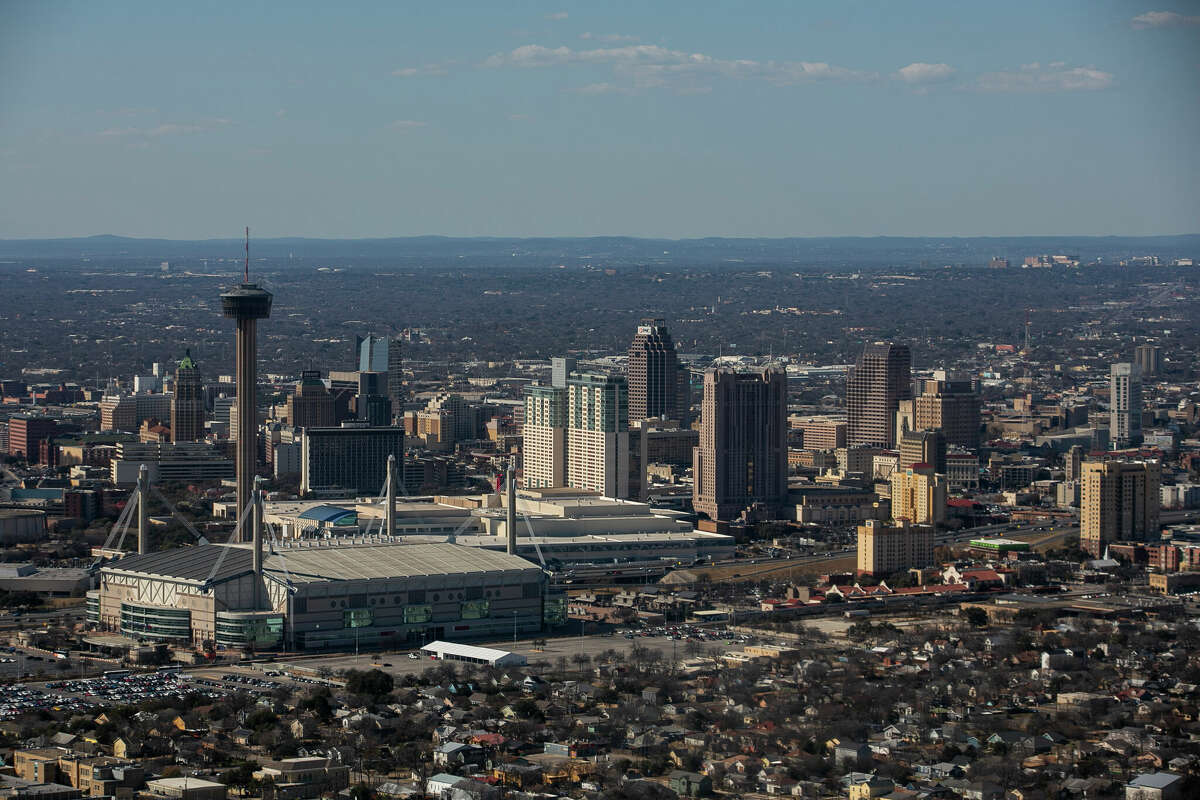
The San Antonio skyline, such as it is, is pictured Feb. 10, 2022.
Josie Norris/San Antonio Express-News
San Antonio Express-News
Shepard Price, San Antonio Express-News
San Antonio is the seventh-biggest city in the country, but it doesn’t feel like it.
So why don’t we have these typical trappings of a major city? The answer comes into focus when you combine the population of the city proper with that of the surrounding area — what’s known as a metropolitan statistical area.
“It’s the size of the market that matters, not the size of the city,” Celeste Diaz-Ferraro, a Ph.D. candidate at University of Texas at San Antonio’s School of Business, said via email. And despite its being a top 10 city for population, San Antonio is only the 24th-largest metropolitan statistical area.
Compare that with Atlanta, which boasts NFL, NBA and MLB teams and previously hosted an NHL team and is likely to do so again. It’s the 39th-largest city, but it’s part of the eighth-largest metro area.
“These differences in structure of various regions are why businesses, economic development agencies and others consider the metro area, not city boundaries, when considering where to invest, locate operations and market products,” Diaz-Ferraro said. “When you realize this, the fact that there are around 400 companies with headquarters in San Antonio is actually pretty darn impressive.”
Still, the city of San Antonio says there’s room to grow economically and in terms of businesses based in the Alamo City. Several problems stand in the way, but the city has a few tricks up its sleeve.
Room to grow
An Economic Development Strategic Framework plan adopted by city officials last year listed several factors that hold San Antonio back, including low-wage jobs that drive down the city's median household income to be the lowest among major U.S. cities.
San Antonio is also among the least-educated major cities in the country. Only 26 percent of residents over age 25 have earned a bachelor’s degree or higher, the report said.
The city also has a higher-than-average poverty rate compared to state and national averages. According to the city of San Antonio’s 2022 Poverty Report, 17.6 percent of the population lives below the official poverty line ($13,465 annual income), which represents an estimated 264,429 individuals.
That 17.6 percent share compares with 14.2 percent for Texas and 12.8 percent nationwide. San Antonio’s poverty rate is third among the five major Texas cities, with Houston at 19.6 percent and Dallas at 18.1 percent.
San Antonio’s median household income ($54,000) is also the lowest among the five largest Texas cities. More households earn less than $15,000 in San Antonio, and fewer households make more than $150,000.
While the Hispanic/Latino and Black residents of San Antonio make up 60 percent and 9 percent, respectively, of the population, Latinos and Blacks account for just 24 percent and 2 percent of business owners. That’s according to capital services firm Next Street's presentation to the City Council’s Economic and Workforce Development Committee.
Next Street notes that deep socioeconomic disparities persist along racial and ethnic lines in San Antonio. In industries hit hardest by COVID-19, Black-owned businesses were overrepresented, while Hispanic-owned businesses are in industries impacted but likely to survive. During the pandemic, small-business revenue and the number of businesses decreased in San Antonio by 45 percent and 35 percent, respectively.
“Addressing these disparities requires solutions that build wealth across all communities in the city, among which are the solutions that present equitable avenues to entrepreneurship and business ownership,” Next Street officials wrote.
Why employers are leaving San Antonio
The city attributes these causes for the loss of major corporate headquarters, like AT&T, and for struggles attracting “new, large private employers.”
The search for easier access to capital resources is another driving factor behind companies moving out of San Antonio, Diaz-Ferraro said.
“I was working as the national brand manager for La Quinta Inns, Inc. when the company was acquired and relocated from San Antonio to Irving, Texas in 1999,” Diaz-Ferraro wrote. “The acquisition and intended expansion from a regional to national lodging chain meant a shift in operations that required greater availability of direct flights for staff who needed to travel to new locations across the country.”
The move to Dallas-Fort Worth also meant greater visibility for the chain in the lodging industry, Diaz-Ferraro said. It was meant to assist the company in future mergers, acquisitions and investment.
In fact, these industry hubs exist within San Antonio. Diaz-Ferraro said some of the industries making their home within the Alamo City include military medical entities, cybersecurity and data centers.
“Because businesses look for an ecosystem of firms with which to do business, networks tend to develop and evolve to emphasize particular industries or related functions,” Diaz-Ferraro said.
What industries do exist in San Antonio
The five industries with the most potential for growth in San Antonio are mobility, IT security and infrastructure, sustainable energy, bioscience anchors and catalysts, and corporate services, according to the city's Economic Development Strategic Framework plan.
According to the public-private greater:SATX Regional Economic Partnership, the city's largest industries in the first quarter of 2023 were government (including military), health care and social assistance (including hospitals) and retail trade.
Meanwhile, professional, scientific and technical services, manufacturing and transportation and warehousing all trail the national average in terms of job share.
More than 146,000 companies employ San Antonio-area workers, including USAA, the Air Force, the Army, H-E-B and Northside Independent School District within the top 10.
Also found among largest employers are the City of San Antonio, University of Texas System, North East ISD and San Antonio ISD.
Companies with more than 500 employees make up just 0.1 percent of corporations in San Antonio. Businesses with 19 or fewer employees make up 84.7 percent, while 96.2 percent have 49 or fewer.
Rory Drew, communications manager for the San Antonio Economic Development Department, notes that the city is working on solving these two major drawbacks.
“Through the City’s Ready to Work program, active steps are being taken to close these gaps,” Drew wrote in an email. “Program leaders work with businesses and education and training institutions to expand and improve key resources, leading to a better equipped population.”
Another liability that the city has in its sights: The San Antonio International Airport is small for a city of San Antonio’s size.
“Through the recently announced expansion of the airport, San Antonio will become increasingly interconnected,” Drew wrote. “The creation of a new terminal and extended runways will support more domestic and international routes directly to San Antonio.”
The lack of building height
Finally, the reason San Antonio isn’t tall is only partially to do with the business environment. A lack of giant corporate interests may help explain why there are relatively few major sports teams for San Antonio’s size, but not so for buildings.
“Inexpensive land is a very common driver of the economic decisions around construction,” Diaz-Ferraro wrote. “You typically only see cities ‘go vertical’ when there are constraints to horizontal expansion.”
Land, especially on the outskirts of the city where San Antonio is growing the most, is cheap. Horizontal campuses, instead of the vertical buildings seen in cities like Dallas, Chicago and Philadelphia, are more popular in San Antonio.
Diaz-Ferraro points to the USAA campus on Fredericksburg Road as an example. H-E-B, closer to downtown, also has a horizontal, spaced-out campus as its headquarters.
There's a "disservice SA boosters have perpetrated, really saying hey, San Antonio is not the small town, it is a large city with lots of resources," Diaz-Ferraro wrote, "but there is a very significant difference between the city boundaries and the metro area."