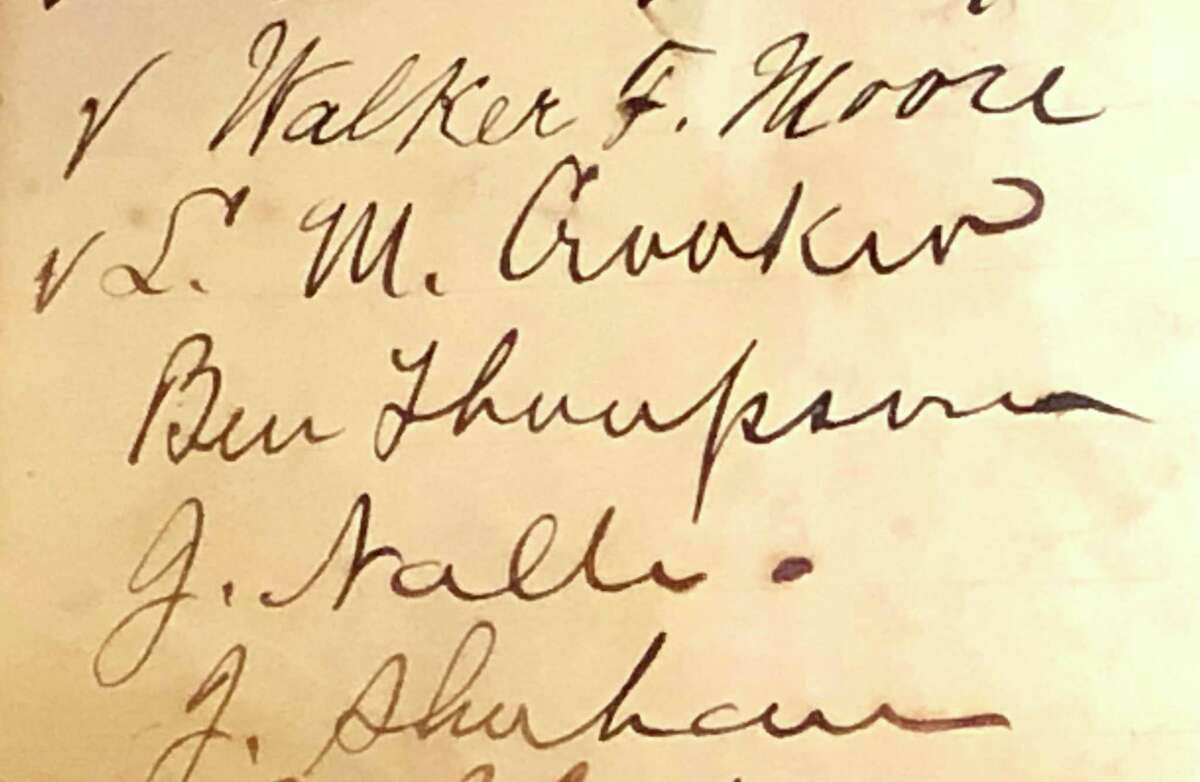
The signature of Ben Thompson, a lawman and one of the most feared gunfighters in Texas, appears in an 1881 registry of the Menger House -- today's Menger Hotel. Thompson was allowed to sleep at the Menger the night after fatally shooting Jack Harris, owner of the Vaudeville Theater in Main Plaza in 1882. The historic registry was on display in the hotel lobby during the Wild West History Association's annual convention at the Menger.
Scott Huddleston
San Antonio Express-News
Scott Huddleston, Staff writer
A North Carolina forensic researcher has a new theory on the legendary 1884 shooting death of former lawmen Ben Thompson and John King Fisher in San Antonio’s notorious “fatal corner” on Main Plaza.
The shootout at the Vaudeville Theater remains somewhat of a mystery. Was it a targeted revenge hit? A wild gunfight inside a crowded theater?
James A. Bailey, a university law enforcement professor emeritus and former special agent with the North Carolina State Bureau of Investigation, believes the theater’s bouncer, Jacobo Santos Coy, wrapped his hand around the barrel of Thompson’s revolver, clearing the way for others to open fire on one of the most feared gunmen in Texas history.
“If he had let go of that gun, Thompson might’ve killed them all,” Bailey told a rapt audience of about 120 history buffs and scholars at the historic Menger Hotel in downtown San Antonio during the Wild West History Association’s annual convention this week.
The shooting made national news, appearing on the front of the New York Times. But it was the beginning of the end of the plaza’s role in Wild West lore, particularly its deadly north end, where the Riverview Towers office building now stands at Soledad and Commerce streets.
Other presentations at the convention featured earlier violent encounters at more or less the same spot.
As ugly as San Antonio politics can get today, it’s nothing like in 1856, when Mayor James S. Devine had a fatal showdown with a former mayor, John Stewart McDonald. Trouble began when McDonald visited Devine’s drugstore, irate in the wake of a heated election, Thomas C. Bicknell, who has co-authored books on Thompson and Fisher, told the history buffs.
“On entering, McDonald demanded Mayor Devine explain a recent insulting newspaper article,” Bicknell said.
Though accounts have varied, Devine was acquitted after pulling his six-shooter and opening fire.
“Stumbling out the door, bleeding badly, McDonald fell before his friends into the dirt of the plaza in front of the fatal corner,” and died within a half hour, Bicknell recounted.
In 1862, William Robertson Henry, angry over losing an election to William G. Adams for the post of captain of a new Confederate company, confronted Adams in the plaza, declaring, “I’m a fighting man.” Adams, at first reluctant but resentful at being called a coward, told Henry to “go to shooting.”
Henry fired first, but the bullet “flew harmlessly across the plaza,” Bicknell said. Adams calmly fired twice. Henry, struck in the head and chest, “died in the dirt in front of the fatal corner.”
The popular Vaudeville Theater at that corner was a two-story, 40-by-110-foot building with a bar, gambling dens and a cigar shop. It was a magnet for “any man seeking a little excitement when visiting the unsavory side of San Antonio,” Bicknell said.
Thompson, a cattle trail gambler and city marshal in Austin, lost about $300 at a faro table run by Joe Foster in 1881. Holding Foster at gunpoint, he got his money back. The proprietor, Jack Harris, threatened to kill Thompson if he ever came back.
When Thompson returned on July 11, 1882. Harris and Billy Simms, another pro gambler who’d been a protege of Thompson’s before their friendship soured, plotted to ambush him.
But the Vaudeville was one of the first commercial businesses with electric lights, which gave Thompson an edge. From the darkened street, he could see Harris inside at the ticket counter. Thompson pulled his gun and fatally shot at Harris, hitting him in the chest.
“When Harris died, he said, 'Thompson took advantage of me. He shot me from the dark,' " said Kurt House, a San Antonio collector and author.
Thompson left the scene and returned to his room at the Menger, pledging to turn himself in to authorities the next morning — which he did, after breakfast. A jury later acquitted him.
It wasn’t long before Thompson was back at the fatal corner. He had turned in his badge by this time, and was becoming unhinged.
On March 11, 1884, Thompson, 40, and Fisher, who was nearly 30 and a former acting sheriff of Uvalde County, went drinking in Austin, then rode a train to San Antonio. They went to the Vaudeville, drinking and smoking cigars in an upstairs theater box.
“Coincidentally, the featured and final performance at the Vaudeville that night was a new play titled, 'Assassination,' " Bicknell said. “Within a few moments, as the music blared away, a volley of gunfire cut down the two gunmen.”
Thompson and Fisher sustained multiple fatal gunshot wounds. Coy was grazed in the leg. Foster bled heavily from a leg wound and died a day later.
House credits the city marshal, Phillip “Phil” Shardein, with preventing further bloodshed. Many were worried Thompson’s brother Billy, a gunman and gambler, would seek revenge. Shardein searched the brother and told him to stay outside, then closed the theater.
A coroner’s inquest found that Thompson and Fisher died from pistol wounds inflicted by Simms, Foster and Coy. But rumors have swirled that other gunmen in the theater participated in a hit that night. No one was ever charged.
Based on a yearlong effort to study the shooting with House’s help, examining ballistics and other details, Bailey believes Coy played a key role, clutching the 7½-inch barrel of Thompson’s .45-caliber, ivory-handle Colt revolver, while Simms and Foster emptied their pistols. Fisher never drew his weapon.
Of the five shots Thompson fired, Bailey believes one grazed Coy and another might have mortally wounded Foster. But the Colt’s long barrel served as a “lever” for Coy to control Thompson’s movements.
“That was not the best choice of lethal revolvers to carry that day,” Bailey said.
Based on witness accounts, he believes the gunfight was contained to one corner of the theater. Thompson and Fisher were killed immediately, with a least one shot fired at no more than 18 inches.
The Vaudeville Theater burned to the ground two years later, and the fatal corner faded into the shadows of San Antonio history.