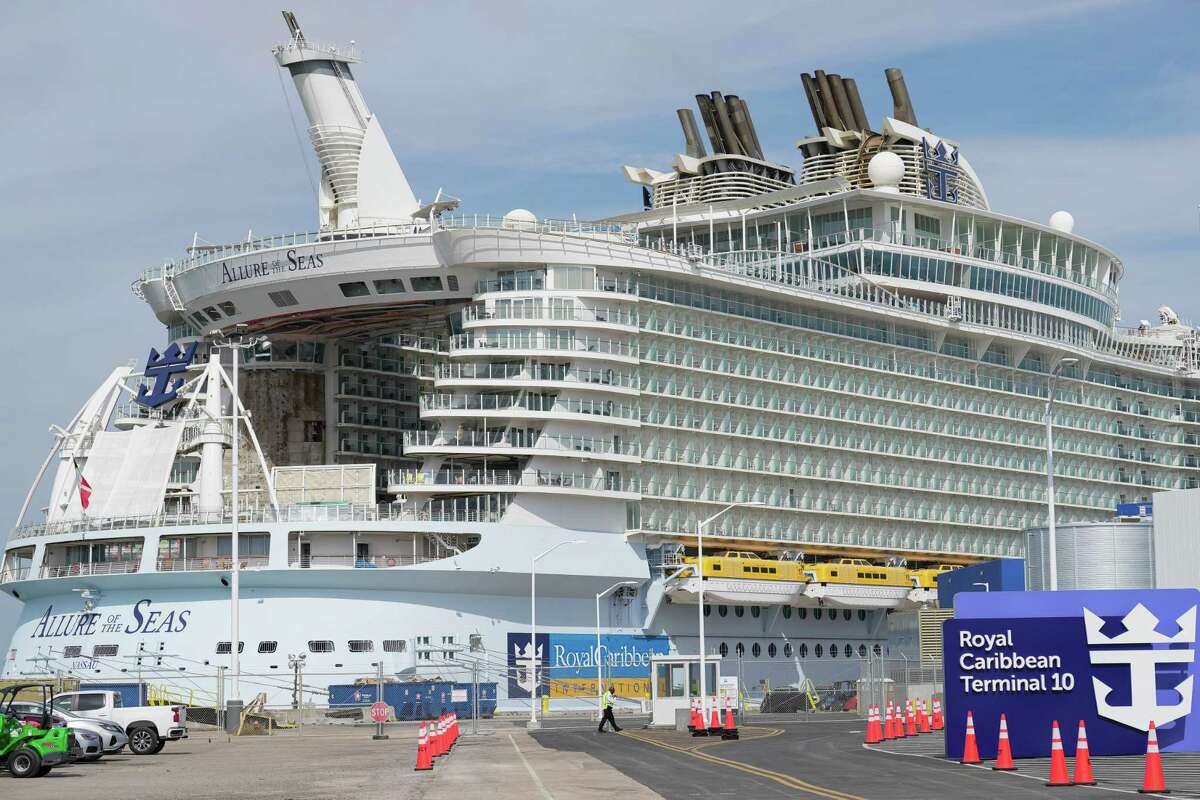
Royal Caribbean's Allure of the Seas is docked Wednesday, Nov. 9, 2022, at Terminal 10 in Galveston.
Yi-Chin Lee/Staff photographer
Houston Chronicle
Erica Grieder, Staff writer
Summer is generally the busiest season for the Port of Galveston’s cruise business, and this year is shaping up to be its busiest yet, according to the port's captain.
Rodger Rees, the port's director and CEO, says the port is on track to welcome an estimated 1.3 million cruise passengers this year, three years after COVID-19 all but sank the business in 2020 and again in 2021.
Last year marked a return to normal, with about a million passengers sailing out of Galveston, Rees said.
“2019 was the best year we’d ever had. 2022 pretty much equaled that,” he said Thursday, noting that the port saw about a million passengers come through last year. “Now, in 2023, we’re looking at a 30 percent increase in passengers. Carnival ships are going out 100 percent occupied. You can’t get one till November, probably."
The relatively small size of Galveston Island, Rees said, might someday cap its cruising activity, but the port's cruising business still has room to grow. And there are other signs that give Reese reason to believe that there's smooth sailing ahead.
The port this week was recertified as a Green Marine port, a voluntary environmental program for the North American maritime industry that the port joined in 2019. Royal Caribbean's new terminal, which opened in December, is bringing the line's large Oasis-class ships to Galveston for the first time. The Port of Galveston also expects to begin renovating a cold storage warehouse — now used for shipments of melons and bananas — into another terminal when its lease runs out in April; that terminal will likely be used by Norwegian and MSC Cruises, a Swiss line that currently doesn't sail from Galveston.
“From our standpoint," Reese said, "we believe we’ve seen the worst that can happen.”
Cruising accounts for about 65 percent of the Port of Galveston’s business, Rees said, meaning that the plunge in cruise travel from 2020 through 2021 cost the Port of Galveston about $58 milllion in revenue. In order to keep everyone employed — a top priority, Rees said, and one the port was able to achieve — it quickly ramped up its service to other types of ships coming to harbor for crew changes, Coast Guard inspections, refueling and other services, historically a far smaller revenue stream.
Despite the pandemic's threat to the industry, Rees said, he didn't worry that it would turn travelers off cruising indefinitely.
“I always knew that this was going to come back. I always felt that way,” he said. “The bottom line is, it’s a good value. People love to cruise. They can go to two or three different places at one price.”
And Galveston isn't alone in seeing cruise traffic riding a new wave, the data show.
“In North America, the booking curve is as far out as we have ever seen it,” said a spokesperson for Princess Cruises, a line owned by Carnival Corp., which sails from Galveston and other ports. “In fact, our booked position across the corporation for 2024 also stands at record levels.”
The demand for cruise travel is stronger than ever, says Anne Madison, senior vice president for global marketing and strategic communications at the Cruise Lines International Association, an industry trade group. Around the world, she added, some 31.5 million passengers are expected to sail in 2023, about 6 percent more than in 2019.
“Cruise is a very resilient sector of the travel economy, and if you look at cruise over past downturns you will find that there was less of an impact on cruise than on other sectors,” Madison said.
That’s in part because cruising makes up a sliver, perhaps 2 or 3 percent, of the overall travel industry, Madison said. But it also reflects the enthusiasm travelers have for the sector. According to a survey the association conducted in March of 4,500 international seagoers, more than 80 percent who've been on a cruise say they plan to cruise again — including 88 percent of millennials and 86 percent of Gen Xers.
“Cruisers love to cruise,” Madison said, adding that this has benefits for non-cruisers, too. “Travel really is the economic generator for communities, but it’s also a social impact. A tremendous positive."
She pointed to some other findings from the association's recent research: Solo cruise travel is on the rise, spurring cruise lines to provide more single-occupancy cabins. Multigenerational trips are also popular.
“It’s a very easy way to all stay together, even amongst people who may have diverse interests,” Madison said.
Another consideration for many passengers is accessibility, with more than 80 percent of the association's survey respondents who have or traveled with someone with limited mobility saying that a cruise was essentially their only holiday travel option.
In another sign of the industry's return, Madison said, there are 70 cruise ships scheduled to be built before the end of the decade, adding to a lineup of almost 300 already on the high seas.
Investors in the companies leading the industry share this optimism. Carnival, Royal Caribbean Group and Norwegian Cruise Line Holdings were among the top-performing stocks in the S&P 500 in the first six months of the year.