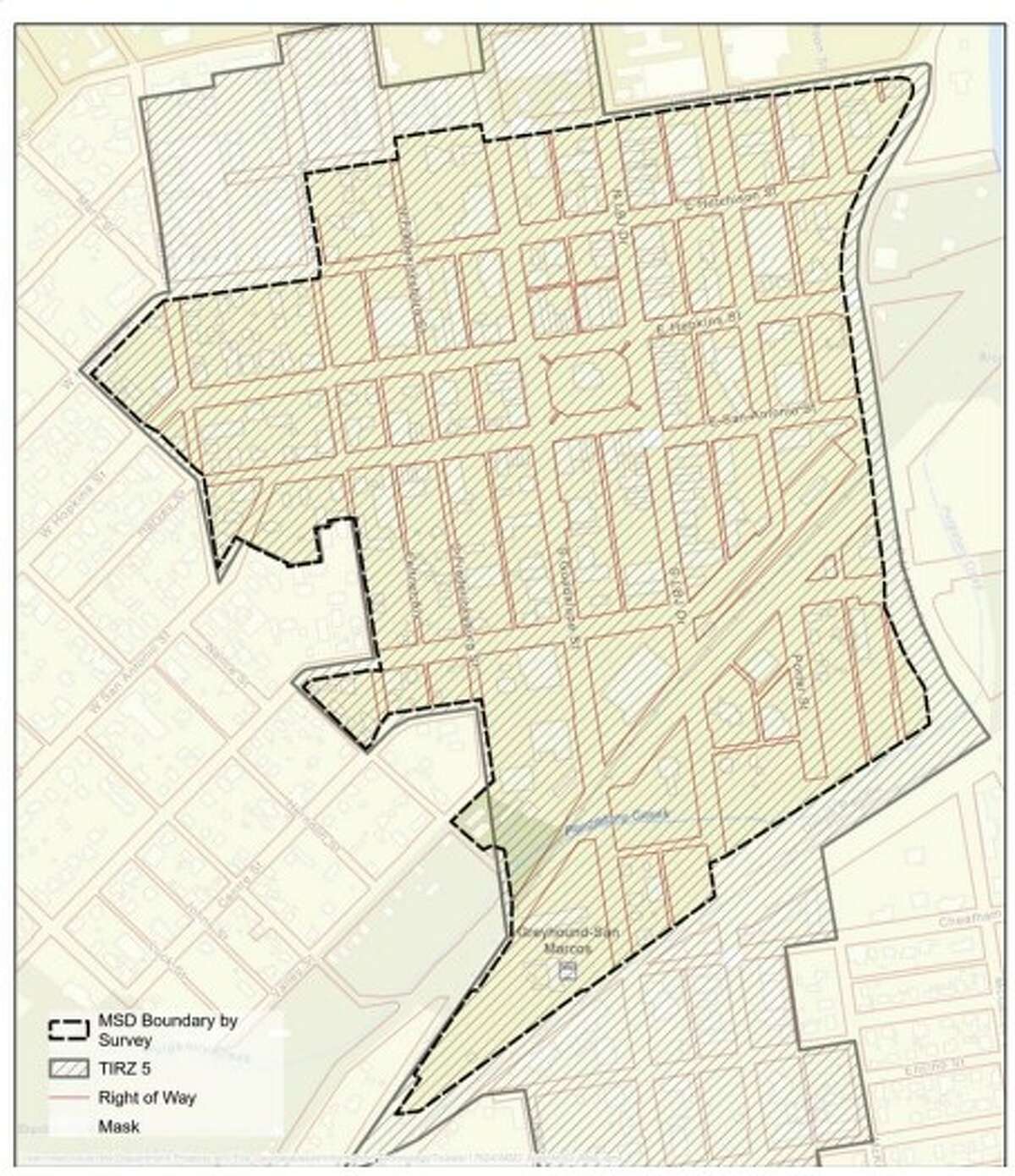
A map from the city of San Marcos shows the proposed boundary of the Municipal Settings Designation, where groundwater would be prohibited from use as drinking water due to contamination. There are currently no wells used for drinking water in the area, which is in downtown San Marcos.
City of San Marcos
San Antonio Express-News
Liz Teitz
San Marcos is trying to avoid an expensive cleanup on three city-owned lots that were contaminated by hazardous chemicals.
The city bought the lots on South Guadalupe Street downtown in 2020 only to find underground “contaminants of concern” left behind from a dry cleaning business that once operated on the property.
The chemical contamination isn't threatening drinking water or rivers in the city, an engineer told the San Marcos City Council, so the cleanup process would amount to "a huge amount of money for relatively little gain." Instead, city staff and consultants are recommending a different approach: Declaring that none of the groundwater around the contaminated lots can be used for drinking water.
The city will ask state officials for a special designation for an area of downtown, known as a Municipal Setting Designation. If the state OKs that status, the city won’t have to remove the chemicals from the properties. That would save San Marcos money and benefit future development, city officials say.
'Basically under control'
The contamination was discovered when the city was buying the lots. The chemicals were left behind by a dry cleaning business that was on the site from the late 1940s to the 1980s. The seller and city entered a voluntary cleanup process with the Texas Commission on Environmental Quality, and began further assessment of the issue.
The groundwater below the site is contaminated with tetrachloroethylene, engineer Cal Chapman of Chapman Engineering told the council. The substance, also known as PERC, is a liquid used to remove oils from fabrics, according to the Agency for Toxic Substances and Disease Registry. Long-term exposure to the chemical can affect the nervous system, liver, kidneys and reproductive system, according to the agency, and can lead to a higher risk of cancer.
PERC is a synthetic chemical, so it can't be broken down by bacteria, but over time it will slowly break down chemically, first into trichloroethene (TCE), then vinyl chloride (VC), Chapman said. Chapman Engineering, which the city has hired for the project, has 14 monitoring wells on and around the property. Four of those show PERC levels at or above the allowed limit for drinking water. Three wells have TCE above the maximum allowed, and two have VC concentrations that are too high, according to the presentation to the council.
Geologist Tony Becker said the "contaminant plume" is about 20 to 22 feet underground, .
The chemicals are moving slowly and the plume is "basically under control," Chapman said. Without the TCEQ designation, monitoring would be needed for "decades, maybe even a century," he said.
Being granted the Municipal Setting Designation would accelerate that process without actually affecting anyone's water supply, he said.
'Not going to be anything left 100 years from now'
The area the city is proposing for Municipal Setting Designation is east of the San Marcos River and south of the Texas State University campus. It includes the Hays County Historic Courthouse and the downtown square.
There are 109 wells identified in the proposed area, but none of them are being used for public or domestic purposes, Chapman said. Like the monitoring wells in use for this project, the other wells in the surrounding area were also dug for environmental assessment and cleanup activities, he said. The city provides water services in the area.
The small amount of groundwater there is already not usable, he said, and the chemicals can't come back up to the surface or seep deeper underground.
That's due to the geology of the site. Becker said the chemicals likely came from a floor drain that was previously on the site, and likely passed straight down through clay and fine sand. Because the chemicals are denser than groundwater, they then reached the Navarro clay formation, he said. That clay prevents the chemicals from moving deeper underground, he said, and also stops the chemicals from reaching the Edwards Aquifer, the limestone cavern system that provides water for more than 2 million people.
The chemicals ultimately break down into carbon dioxide, chlorine and water, Chapman said. "There's not going to be anything left 100 years from now to say we ever had a contaminant problem on our hands," he said.
Mayor Jane Hughson asked if the monitoring wells were actively removing the "crud" from underground.
But doing so is hunting for needle in a haystack, Chapman said. "The levels we're measuring in the water are below one part per million," he said. Instead, they're doing what he called "babysitting," with long-term monitoring, and conducting semi-annual analysis of samples from the wells to ensure the contaminant plume is stable.
The groundwater on the site doesn't seep up to the surface, and he and Becker said the location and nature of the chemicals mean they won't move back up from underground.
If the city had to clean up the lots, it would be an expensive process. Becker told the Express-News remediation would require pumping water from larger wells, using a treatment system, likely with activated carbon, then discharging wastewater.
After hearing a presentation in their work session, city council members agreed to have staff move forward with the process, though they didn't take a formal vote. Certified letters will be sent to all well owners within a half mile of the proposed boundary, and the owners will have 60 days to send their comments to the TCEQ. The city will have to pass an ordinance formally prohibiting use of groundwater as potable water within the boundary, which must then be submitted to the state agency.
The city purchased the lots on South Guadalupe "to facilitate redevelopment in our downtown," San Marcos downtown coordinator Josie Falletta said, but no decisions have been made for their ultimate use. Some conversations have included city offices and facilities, and a recent plan from the Capital Area Metropolitan Planning Organization identified opportunities for mixed-use residential, retail and office space on the land.
In the short term, the city is recommending parking and an "interim activation" there, which could include lighting, seating, bike and scooter parking and space for events.