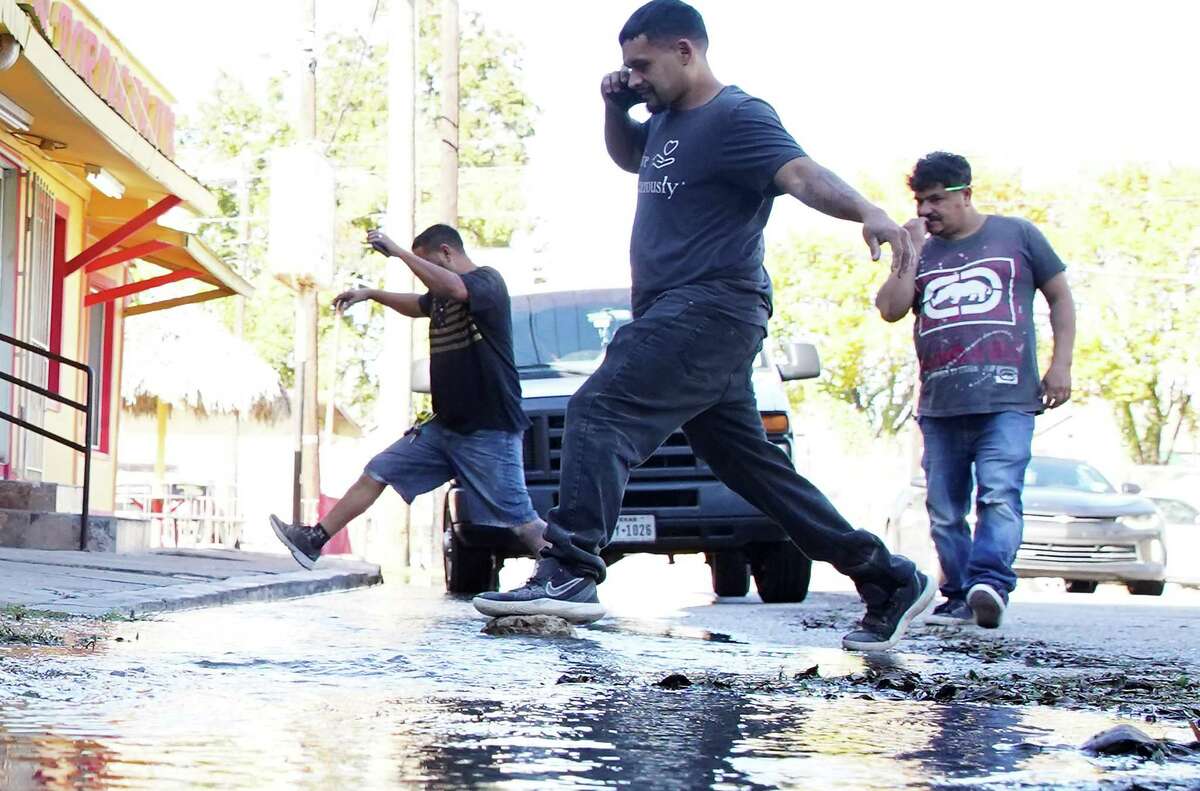
Customers at Laredo Taqueria try to keep dry as they step over an ever-growing puddle from water flowing out of the ground on Wednesday, Nov. 30, 2022 in Houston.
Elizabeth Conley/Staff photographer
Houston Chronicle
Yilun Cheng, Staff writer
The city shelled out $34.6 million to fix damaged water pipes in the fiscal year that ended in June, new data obtained through a records request shows. This marks a significant jump from the of $9.2 to $10.5 million it spent repairing pipes in each of the previous four years.
Along with the 30 billion gallons of water lost in 2022, the city lost another 9 billion gallons from January to April 2023, according to the latest data. At times, Houston lost of over 20 percent of its total water supply for the month. Combined, this loss represents roughly $150 million in potential annual revenue for the water utility system.
“Houston Public Works is doing everything within our funding, within our capability to address water leaks and to try to reduce and maintain what we can,” said Erin Jones, a spokesperson of the Houston Public Works Department.
The steep rise in water leakage and repair expenditures stemmed largely from Houston’s ongoing drought conditions and the recent winter freeze, Jones said.
In June 2022, record temperatures and a sharp drop in rainfall prompted the city to issue a drought advisory asking residents to limit outdoor watering and check frequently for leaks. It was the first drought advisory since the more severe state-wide drought in 2011.
Since then, persistent dryness and drastic temperature changes have caused the ground to move and shrink, Jones explained, leading to damage to the city’s aging pipes.
Additional hurdles – including a constrained budget, reduced summer productivity and escalating costs of repair materials – have further complicated the department's efforts to tackle the growing number of pipe breaks, she said.
Houston lags behind in water loss control
Utilities throughout the United States have long struggled with water loss due to old and poorly constructed pipelines, lack of corrosion protection, and neglected valves, research shows.
Greg Kail, a spokesman for the American Water Works Association, said the top concern of water utilities across the nation consistently circles back to infrastructure maintenance.
“Almost every year in our survey, the top issue that our members tell us is on their minds is always infrastructure and how to finance it,” Kail said. “We hear a lot about emerging contaminants, about climate risks, all these things, but what is consistent is the need to maintain infrastructure.”
On average, about 14 percent of all water treated by utilities is lost through leaks, according to the U.S. Environmental Protection Agency.
Many states set the benchmark for acceptable losses to between 10 and 15 percent of the water produced. While some fluctuations are normal, losses exceeding 20 percent of the total supply should call for immediate attention and corrective actions, guidelines from the National Drinking Water Clearinghouse said.
Houston recorded a loss of over 20 percent of its total monthly water supply at least five times since the start of 2022, most recently in March.
Water loss percentages for other utilities during this time are not immediately available. However, past reports suggest Houston's water loss control has often lagged behind other major Texas cities even before the current drought.
In 2011, Houston reported losing 18 billion gallons of water, averaging 111 gallons per customer per day. In contrast, Austin, Dallas and San Antonio recorded lower rates of 89, 78 and 51 gallons lost per connection daily, respectively.
Meanwhile, efforts to replace Houston's 7,600 miles of water pipes have waned considerably over the past decade, slipping from around 140 miles replaced in 2014 to just 10 miles in 2022, data from Houston Water shows.
Currently, about 32 percent of the city's existing water lines are made from outdated materials like cast iron and asbestos concrete, which have historically been responsible for most of the breaks.
Houston Water's drinking water operations director, Venus Price, previously told the City Council that the slower pace of replacement in recent years was due to significant spending after the 2011 statewide drought. She added that recent water rate hikes should allow the city to speed up its replacement efforts again.
Officials and advocates highlight conservation needs
These water losses come as the city is anticipating worsening water shortages due to its booming population.
By 2070, Houston's metropolitan population is projected to rise from 4.7 million to 6.2 million, the Texas State Water Plan projects, leading to a potential water shortage of 220,772 acre-feet per year — an amount larger than the entire volume of Lake Houston.
To mitigate this projected shortfall, Houston Water has launched an education campaign called "Give Water a Break". The initiative seeks to secure 18 to 28 percent of additional water supplies through conservation efforts to meet rising demand in the upcoming decades.
“Our biggest point right now that we're trying to hammer home to people is that we need to help conserve water,” Jones said. “We're trying to do the best we can with repairing water leaks from the aging infrastructure. But a lot can be done on the consumer side as well.”
Others, however, said the utility itself should shoulder more of the conservation responsibility. Adrian Shelley, the Texas office director of Public Citizen – a D.C.-based nonprofit advocating for environmental issues and consumer rights – said that the current levels of water loss and the escalating repair costs are unsustainable.
“It's easy to say that this is just the product of extreme weather, but spending $35 million a year just to keep the worst of disasters from happening is not a good investment for the city at all,” he said. “That's simply unsustainable, particularly given how precious the water resource is becoming.”
Over the past year, a large portion of the city’s repair expenses were made in the form of emergency purchases in response to an unforeseen level of pipe damage, as detailed in past City Council agendas. Shelley said the city needs to more proactively plan out its infrastructure expenses rather than relying on patchwork repairs that seem to be getting more costly.
“Our infrastructure seems to be starting to fail more reliably and on a more significant scale,” Shelley said. “We're just not making enough large-scale investment in upgrading the infrastructure to gain any ground.”