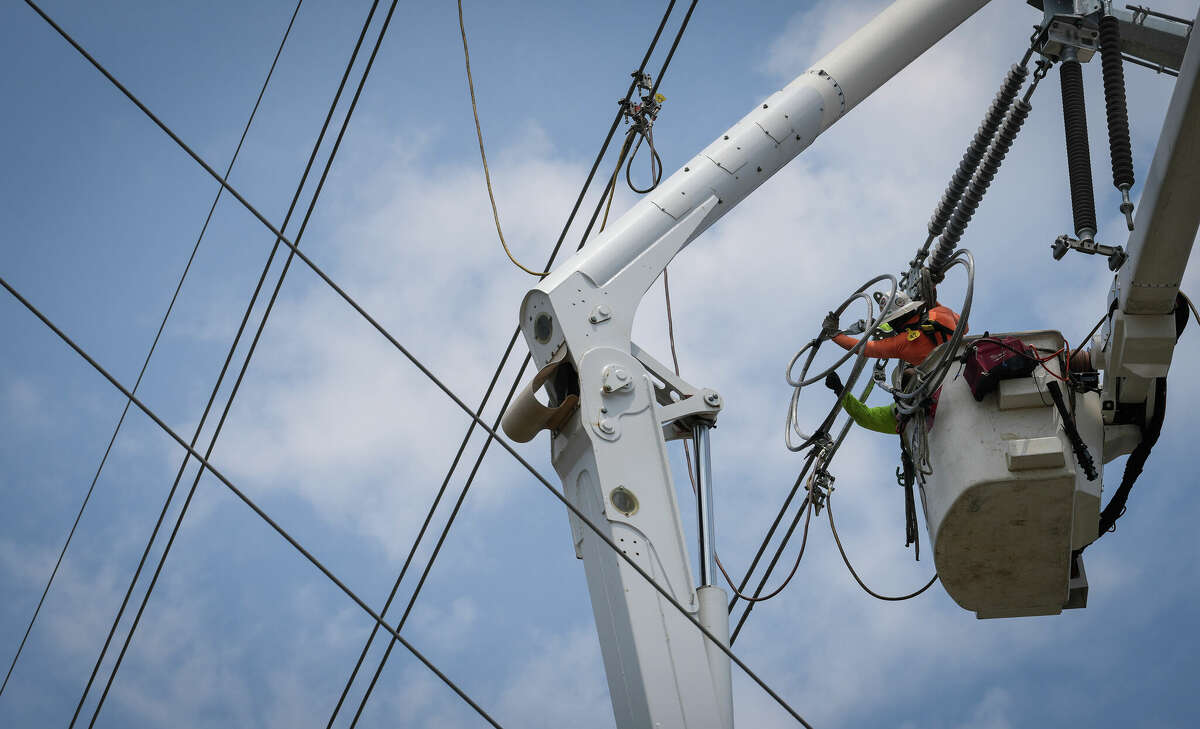
Men work on transmission lines Wednesday, June 21, 2023 in the Montrose neighborhood in Houston.
Jon Shapley/Staff photographer
San Antonio Express-News
Sara DiNatale, James Osborne, Staff writers
Now two years later, federal regulators are looking at new rules that could force it to happen.
The Federal Energy Regulatory Commission is considering moves that could force power grids in Texas and other states to connect with one another to reduce the chance of a large-scale blackout.
The commission this week said its rulemaking focused on creating minimum interconnection capacity between grids could include Texas. The regulatory body has authority to set reliability standards for the Energy Reliability Council of Texas, which operates the Texas grid.
“Whether, and to what extent, Texas is implicated would depend on the specific action that FERC takes and under what authority it takes that action,” the spokesperson said.
It’s a move politicians in Texas have long resisted out of concern it would bring them under greater federal regulation. But officials at CPS Energy and others have said that if they’d had the option of importing power from across state lines in 2021, the outages may not have been so severe. And if they could sell excess power outside Texas, it could lead to savings for ratepayers.
Officials at CPS declined to comment this week on how it could be impacted by mandated interconnection. But the city-owned utility’s own report published after Winter Storm Uri advocated for connections outside the state to improve the grid’s reliability.
‘It will help’
During a 2021 trustees meeting, then-CEO Paula Gold-Williams said interconnection, and the ability to purchase power out-of-state should its own power plants fail, would be helpful.
“We should look at interconnections as an option,” she told trustees. “It won’t solve everything, but it will help.”
Outside of security during weather emergencies, it could also bring new revenue to Texas, said Michael Webber, a professor in energy resources at the University of Texas at Austin.
“I’m a huge advocate for more connections,” he said. “This is silly. It would save us money, it would be more reliable and it would be cheaper for customers. We could make more money selling extra power.”
Webber said most of the arguments against interconnection stem from “identity politics.” He acknowledged it could mean additional administrative oversight but said the benefits outweigh that concern.
Since last summer, power companies across Texas collectively added more than 3,000 megawatts of solar and another 1,000 megawatts in wind generation, according to ERCOT. The extra capacity coming from solar power especially has kept the state’s high demand records from pushing the grid to its limits this summer. But at times, there has been
plenty of surplus — and that’s power companies like CPS could be selling outside the state.
That new revenue could then help reduce rates paid by customers, Webber said.
Alleviating concerns
Webber said that with the ability to sell power outside of the state, it’s likely even more Texas land could be used to add more solar and wind generation.
“The conversation is not new, its been happening since the '60s,” he said of the perennial interconnection debate. “But because of Uri and the concerns of reliability, it has different legs this time.”
A spokesperson for the Texas Public Utility Commission, which oversees ERCOT, declined to comment on the rulemaking underway at the commission and in Congress.
Though it’s faced political pushback, Pat Wood, a Houston-based energy consultant and former Federal Energy Regulatory Commission chair, said those concerns can be alleviated. Were the federal government to assure Texas leaders the state would come under no additional regulation around wholesale power markets or other policy, the proposal to set minimum connection requirements could potentially win the support of politicians in Austin.
“The question is, is it in the public interest? And the answer is yes,” he said. “The question is: Will (FERC) do it? People are scared of the jurisdictional issue. Nobody wants to piss off anyone in Texas.”
D.C. politics
In Congress, lawmakers already are adjusting their efforts to expand grid interconnections to mollify Texas.
Sen. John Hickenlooper, D-Colo., and Rep. Scott Peters, D-Calif., have announced plans to introduce legislation that would require power grids nationwide to maintain interconnections with neighboring grids covering at least 30 percent of peak power demand. In the case of Texas, that would mean the construction of transmission lines capable of delivering 25 gigawatts of electricity — enough to power 22 million homes — to Louisiana, Arkansas, Oklahoma and New Mexico.
In their initial proposal in May, the congressmen planned to include Texas in the legislation under the condition it not expand FERC’s authority over the state’s power grid. But they have since changed the bill to make Texas’ participation voluntary, a congressional staffer said.
The staff member declined to say why they had made the change.
To what degree more interconnections would have alleviated the 2021 Texas blackout is also a topic of debate: Neighboring grids that were also struggling to keep the lights on might not have been able to deliver a significant amount of electricity to Texas.
But many experts say that at a minimum, they would have helped reduce the scale and duration of the blackouts.
Asked about the legislation’s potential benefits to Texas, Alison Silverstein, an Austin-based energy consultant and former adviser at FERC, said each additional gigawatt of connection to neighboring grids would have saved nearly $1 billion over the four days Texans were left in the dark.
“This straightforward approach,” she said in an email, “would protect against extreme events like Winter Storm Uri, which in 2021 took 4.5 million Texas residents offline, killing hundreds and increasing energy prices 100-fold.”