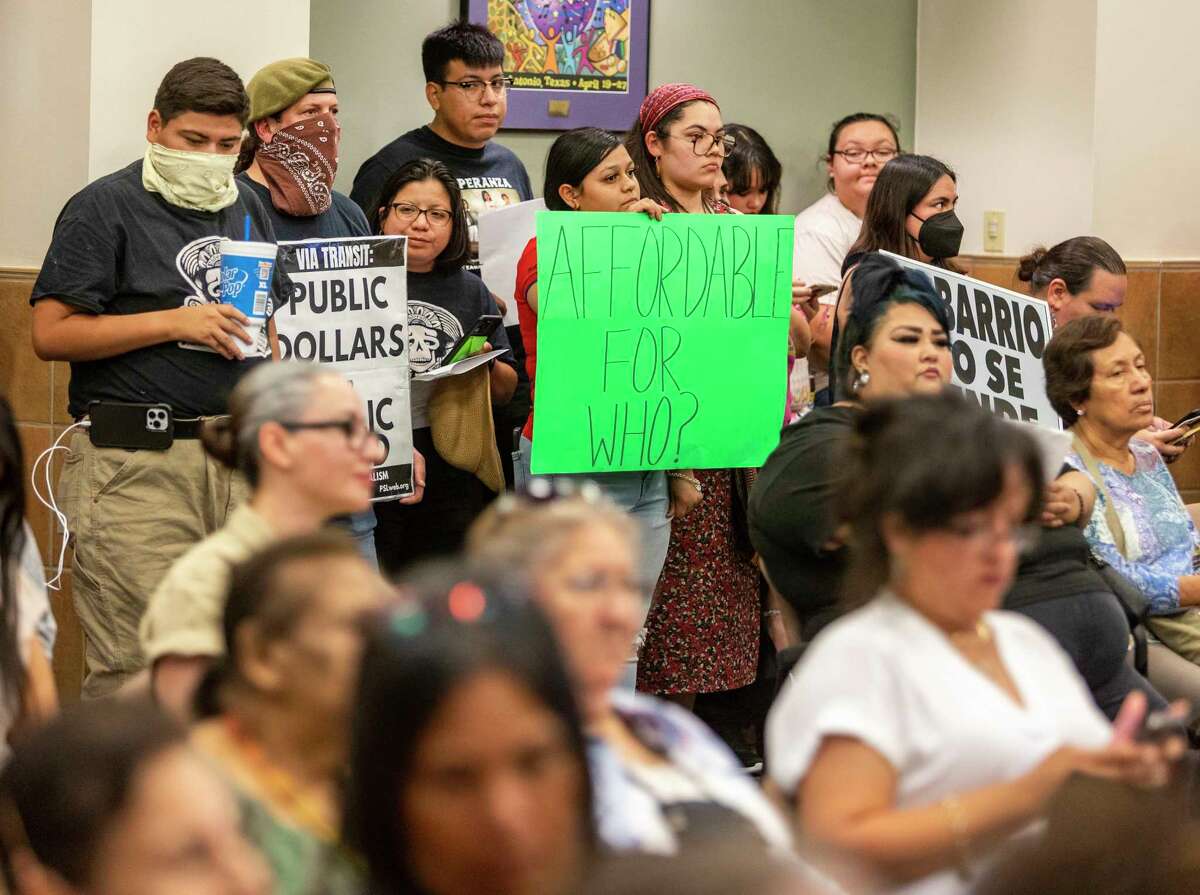
People opposed to VIA Metropolitan Transit’s proposed development plans for the Scobey complex, a row of industrial buildings on the near West Side, attend a board meeting Tuesday, May 23, 2023, at the transportation authority’s Metro Center.
William Luther/Staff
San Antonio Express-News
Madison Iszler, madison.iszler@express-news.net
May 24, 2023
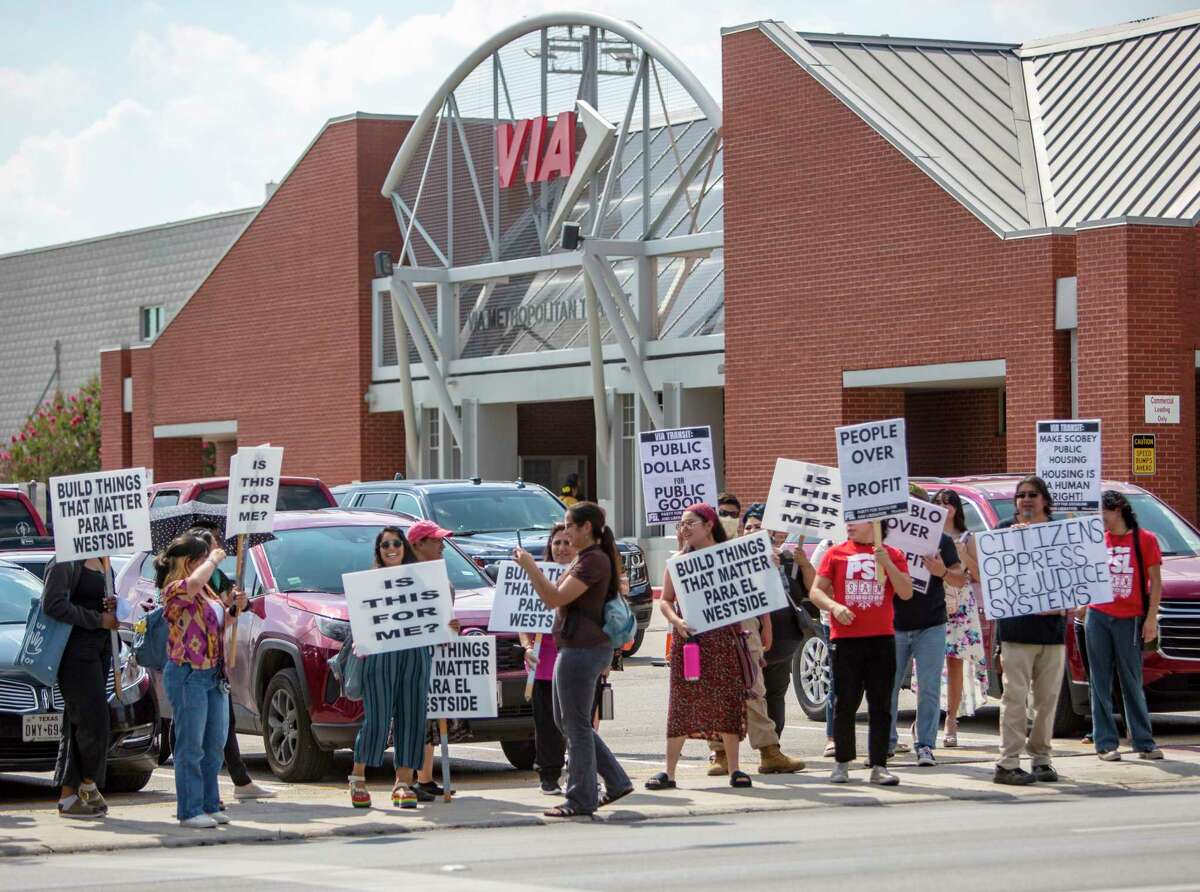
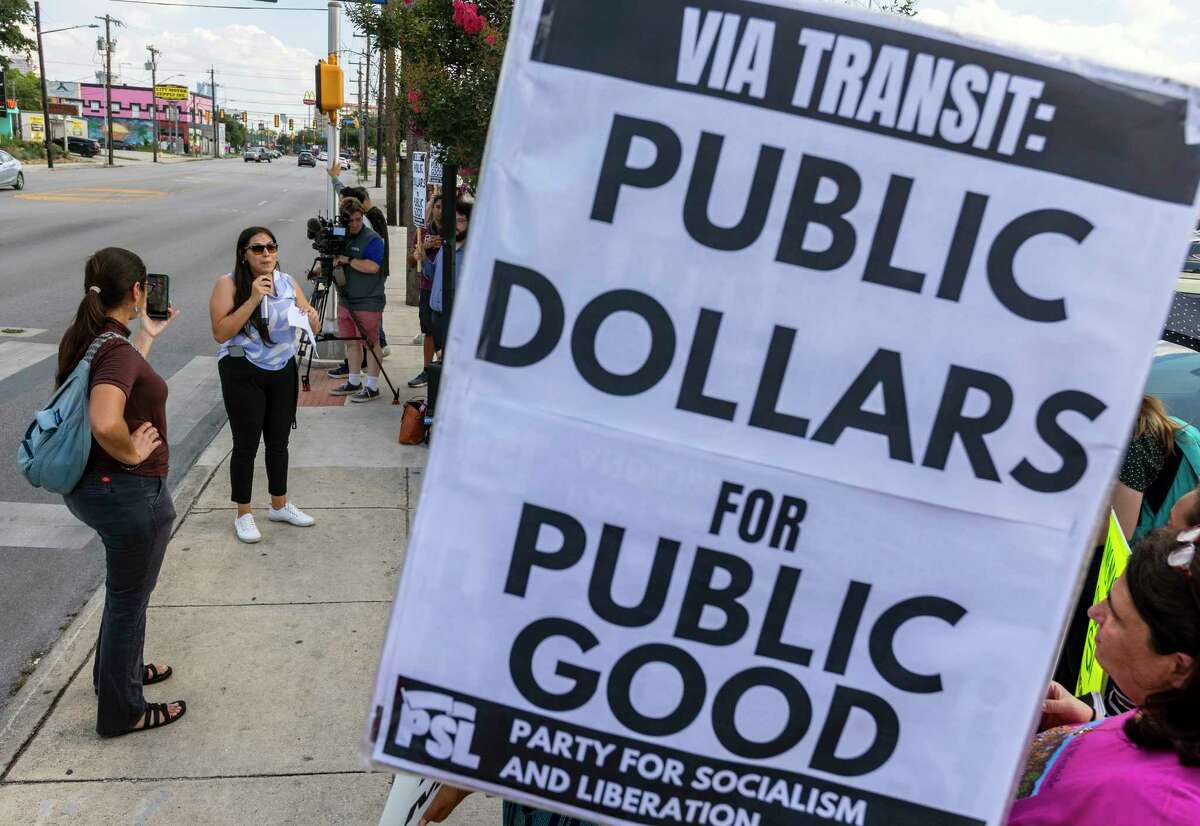
After picketing outside the city transit agency’s headquarters, nearly three dozen people packed into the board room or left messages with most expressing worries that the project won’t include enough housing for families at the lowest income levels. That, they said, is a necessity in a neighborhood whose residents are struggling with poverty and homelessness and rely on VIA for transportation.
“Our association supports economic development that would benefit our residents and that would help to reduce the housing needs of our residents,” Leticia Sanchez of the Historic Westside Residents Association told trustees. “If VIA wants to become a housing developer, it cannot ignore the housing crisis that exists in our city, particularly for people who earn 30 percent (of the area median income) or below.”
Others said they want more businesses beyond the heavy supply of bail bonds companies there because of the nearby Bexar County Jail, and voiced optimism that redevelopment could make the area feel safer. Beyond the jail, the Scobey complex at 301 N. Medina St. is surrounded by railroad tracks, government facilities and the Haven for Hope homeless shelter.
Graciela Sanchez, who leads the Esperanza Peace and Justice Center, said her organization also generally supports redevelopment but thinks it could be more beneficial with some tweaks.
“Yes to restoring and rehabbing the building, but no to the housing that you currently are developing,” she said.
The project, which has been in the works for years, has drawn earlier concerns and questions about the propriety of a transit agency getting into the development business. Its board and CEO say the “transit-oriented community” is a natural step for the neighborhood around its Centro Plaza transit hub, and mirrors similar developments in other major
cities.
William Luther/Staff
'Offers opportunity'
Ramiro Gonzales, who leads Prosper West San Antonio, told trustees he sees it that way.
“It offers the opportunity to bring jobs, investment, customers and vibrancy to a critical gateway of the West Side. It will also help to abate the criminal activity and vagrancy that currently dominates that immediate area,” he said.
A West Side developer said he likes the idea, too.
The proposed plan “promotes mixed-income housing, and yes, make sure some of it is deeply affordable, but please don’t abandon this project, because if you don’t start others won’t come, and we need a lot of affordable housing,” said Dix Densley, a broker and developer who owns property in the area.
Others asked VIA to be more communicative about the development and to work with them to refine it.
“Y’all have an opportunity to either perpetuate the disparities that we’re seeing in District 5 or create an opportunity where we can progress together,” said Councilwoman Teri Castillo.
“For too long, the community has not been taken into account and has been left to fend for itself for decades,” said Jaime Macias, who owns Jaime’s Place bar on the West Side. “All of a sudden now there’s newfound interest in our community. Taxes are going up, people are being displaced, and those of us that have been there since the late '50s, '60s, we’re trying to find a way to maintain our existence there and to continue to enhance the beautiful culture that has long dwelled in the West Side.”
VIA trustees did not take an action on the Scobey proposal and mainly discussed it in a closed session.
William Luther/Staff
Project’s history
The agency bought the Scobey complex in 2017 for $5.2 million from partnerships managed by local developer Ed Cross, who was unsuccessful in remaking it.
VIA later decided to work with San Antonio-based DreamOn Group and the Geyser Group of Austin to transform it into as many as 120 apartments, 32,000 square feet of retail space, 26,500 square feet of office space for VIA and 36,000 square feet of storage. About 35,000 square feet of outdoor space and 200 parking spots are also part of the project next to VIA’s Centro Plaza transit hub and headquarters.
Forty percent of the units would be for families earning up to 150 percent of the area median income, according to a presentation to trustees. Another 40 percent would be for families making up to 80 percent of the area median income and 10 percent would be for those making less than 60 percent of the area median income.
VIA was not immediately able to provide corresponding rents. The remaining 10 percent of the units would be rented at whatever rates the market can fetch.
The transportation agency would pay $26 a square foot to rent the office space — a figure some trustees have questioned — and rent would increase 2 percent each year. It would also spend $4.9 million to finish out the space. It would not own the office space initially but would buy it for $15 million after seven years.
VIA would receive a share of the cash flow from contributing the Scobey property and a share of the profit after a certain return threshold is reached.
For the residential portion, the agency would get a capital account balance of 51 percent of the development’s value and an 8 percent preferred return. For the commercial portion, it would receive a capital account balance of 49 percent and 10 percent of the promote the developer will get from building the space.
The apartments would remain tax-free because that portion is owned by VIA, but the commercial portion would not be tax-free because VIA would not own it. A local government corporation set up by VIA would act as the general contractor and materials bought for construction would be exempt from sales tax.
VIA would receive ground rent of $190,000, which would rise based on the profitability of the development each year until it reaches an amount equal to 25 percent of the taxes that would be paid if the residential portion was taxable.
In February, trustees approved a nonbinding term sheet to allow DreamOn and Geyser to identify financing sources for the development, which could include tax credits, equity and debt. It is still subject to negotiations and the next step would be drafting a joint development agreement, which would need approval from VIA trustees.
An open house will be held in June after being canceled this month due to weather, and the developers are working to meet with West Side groups to discuss the project, according to the presentation Tuesday to trustees. They are also asking for feedback through an online survey posted on DreamOn’s social media.
Construction could begin in 2024 and conclude in 2026.
madison.iszler@express-news.net