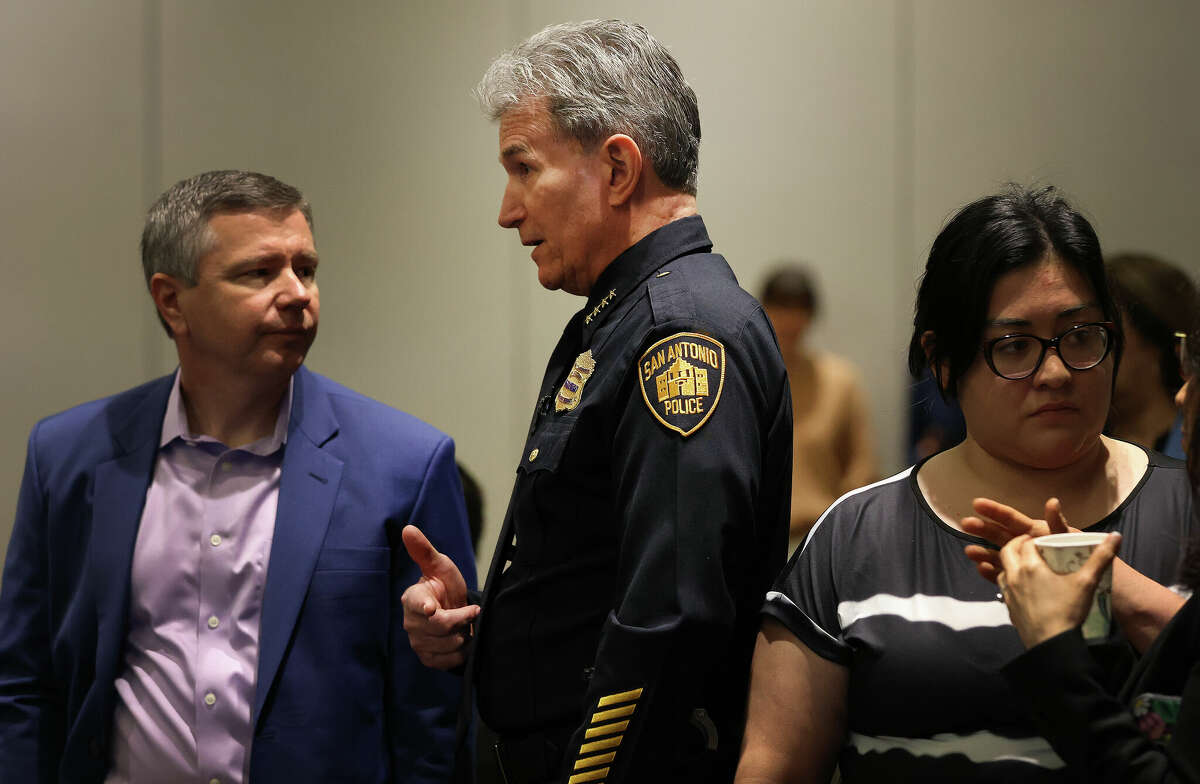
Police Chief William McManus (center) chats with Chief Financial Officer Ben Gorzell as the mayor, City Council and city staff convened on Apr. 13, 2023 for a day-long budget work session.
San Antonio Express-News
Molly Smith, Staff writer
A 20-slide presentation is at the heart of the San Antonio Police Department’s $8.6 million request to add 100 patrol officers next year.
It’s part of a larger, long-term staffing plan that would cost the city an estimated $52 million by 2027.
The slides, which largely categorize calls to police for help, were the first step in what was to be a “comprehensive staffing analysis” that public safety consultant Alexander Weiss began last July. His study was to address whether the SAPD had enough officers on the streets to keep San Antonians safe, or whether the department needed to go on a hiring spree.
Weiss never finished the study — the Evanston, Illinois-based expert on policing died of an illness Feb. 1, seven months after landing the $140,000 city contract. He'd collected $40,000 from at the time of his death.
He left behind the slides, but no written report. He hadn’t started work on some parts of the analysis.
Are 20 slides a strong enough foundation to base the police department’s hiring plan on?
District 5 City Councilwoman Teri Castillo, for one, has called on city staff to wait until another consultant completes the analysis that Weiss started before proposing a hiring plan, or at least reviews his work.
“I feel it sets precedent by taking on an incomplete study to shape budget and policy,” the West Side councilwoman said in April during council’s first session on 2023-2024 budget.
City administration leaders, however, say they have the information they needed from Weiss.
Assistant Police Chief Robert Blanton said he had no reservations moving forward with the hiring request. “I don’t think the chief did either,” he added, referring to Chief William McManus.
Neither did Deputy City Manager María Villagómez, who oversees the police department. She said Weiss completed his analysis of the number of patrol officers needed to achieve his recommended balance between time spent responding to calls and time spent on proactive policing — activities such as monitoring a shopping mall parking lot to deter vehicle break-ins or running radar in school zones to catch speeding drivers.
“We feel confident that he completed that, based on conversations with him and work that he also had done for other clients,” Villagómez said.
Mayor Ron Nirenberg and nearly the entire City Council have embraced — and pushed forward — SAPD’s plans for it largest staffing increase since 2009. In late April, the council, including Castillo, gave the city the go-ahead to pursue a federal grant to offset the costs of 50 officers.
“We need more city services to handle the amount of population increase that we’ve had in the last several years,” said District 6 Councilwoman Melissa Cabello Havrda, who chairs council’s Public Safety Committee.
In addition to an influx of new residents, crime rates have been on the rise. The city saw more than a 10 percent increase from 2021 to 2022 in overall crime, with noticeable spikes in property and violent crimes. Over the last three years, violent crime — murder, aggravated assault and robbery — rose 47 percent.
Cabello Havrda said a majority of council members likely will support including SAPD’s hiring plan in next year’s budget, which City Council will adopt in September.
More time for 'proactive' policing
Authorizing 100 additional patrol officers would be the first phase of a five-year plan to add a total 360 patrol officers to the force — a 32 percent increase from the 1,128 patrol positions in the current budget.
The city arrived at the 360 figure by deducting the current patrol positions from the total number that Weiss had recommended, Villagómez said. His recommendation was based on achieving a 40-60 split between the time officers spend responding to calls for service versus time for administrative and proactive police work.
Officers currently spend about 60 percent of their time “on call.” In 2022, SAPD responded to more than 2.3 million emergency and non-emergency calls.
“When you’re answering that radio, going call to call to call without a lot of time in-between, you sort of get in a pattern where that’s kind of what you do,” Blanton said. “So there’s less proactivity. There’s less community engagement — just talking to folks.”
Hiring additional officers would reduce response times, improve residents’ perceptions of safety by increasing police visibility, and lead to better interactions with officers, who would face less pressure to move on to another call, he said.
SAPD’s goal in hiring an external consultant was “to determine what the proper staffing levels would be within the police department both in the patrol operations bureau and in the investigative bureau,” Chief William McManus told council’s Public Safety Committee at a June 2022 meeting.
At the time, the chief said the study would be finished within six months after the contract was signed.
The “workload-based staffing” model that Weiss used is the method that criminal justice experts and police unions favor. It ties staffing to calls for service and response times. It's a departure from the per-capita staffing approach, which ties the number of officers to population size — a model long favored by police departments and cities.
Adding 100 patrol officers would cost $8.6 million next fiscal year, according to a recent city budget briefing. That cost assumes the city will be awarded a U.S. Department of Justice grant to cover partial costs for 50 new officers over a three-year period.
San Antonio applied for the same grant last year but didn't receive it. If the city is once again denied the funding, Villagómez said the overall cost to the city would be closer to $11 million.
The city aims to add 65 patrol officers annually from fiscal year 2024 to 2028, until it reaches 360 new officers.
By the start of fiscal year 2028, which begins October 2027, that hiring plan would have cost the city an estimated $52 million. It would put police and fire spending at 66.2 percent of the city’s general fund budget — a sliver above the 66 percent public-safety spending cap San Antonio has followed since 2014.
‘Irresponsible to go all-in’ on hire
From the time the city hired Weiss to his death in February, he produced a 20-slide presentation entitled “SAPD Patrol Staffing Interim Briefing.” The city released 12 of those slides in response to an open records request for all documentation related to the staffing analysis.
The city is seeking to withhold the remaining eight slides, citing their mention of “which locations have a slower response time, and how much time is available to commit criminal acts for specific areas of the city.”
That presentation was based on Weiss’ analysis of call data from September 2020 to August 2022. One slide breaks down the percentage of calls by day of the week while others detail the numbers of calls per police substation and the most common types of calls. Other slides focus on officers' time-off requests.
The slides formed “the basis for (Weiss’) analysis and assessment,” Blanton said. “He may tweak that or augment that through some interviews, focus groups, that kind of thing, but it’s really just what’s the demand (for calls) and what is the time that wastes that demand, and then how do you staff to achieve a certain ratio to address that.”
Neither a draft of the final report nor the presentation of findings to “identified stakeholders” were completed.
“I believe that it’s irresponsible to go all-in with 100 patrol officers without a full study,” Councilwoman Castillo said at council’s April 13 budget goal-setting session, which kicked off the city’s months-long budget process.
She said she would “feel more comfortable” if another consultant reviewed Weiss’ work.
Castillo did not make herself available for an interview for this story.
This year, the city budgeted $905 million for public safety, which includes police, fire and parks police. That accounts for 60.5 percent of the general fund budget, which pays for street repairs, libraries, senior services and numerous other basic services, in addition to public safety.
In the early draft of next year’s budget, which kicks in Oct. 1, public safety spending would increase to $955 million. That would take up 61 percent of the city’s general fund.
Texas law effectively bars large cities, including San Antonio, from cutting law enforcement funding from one year to the next.
SAPD currently has authorization for 2,588 uniform positions and 620 civilian positions.
Future staffing requests
Castillo has pressed for boosting police visibility in the community by hiring additional officers for SAPD’s mental health unit and its SAFFE (San Antonio Fear Free Environment) unit, which is focused on community policing. This would be a way of the city “being intentional with public safety,” she said at the April 13 meeting.
Cabello Havrda said she, too, supports increasing the number of SAFFE officers, and so do her constituents.
The SAFFE unit includes 124 officers and 12 supervisors. The trial budget did not include new positions for this unit.
“We need a majority of council to push for” increasing SAFFE officers, Cabello Havrda said. “I don’t know that we have that right now, but I don’t want to have to wait another year. But I also don’t want to decrease the number of patrol officers.”
Hiring 100, and potentially up to 360 officers, would come with “tough questions” for SAPD down the road, she said, including whether response times and the number of calls for service — and the amount of crime — have decreased.
“We only have so much (money) to go around, and there’s a lot of criticism for how much of the budget gets spent on public safety — on fire and police — and I understand that,” she said. “At the same time, you have community members who are really, really disappointed at the level of crime in their neighborhoods.”
molly.smith@express-news.net