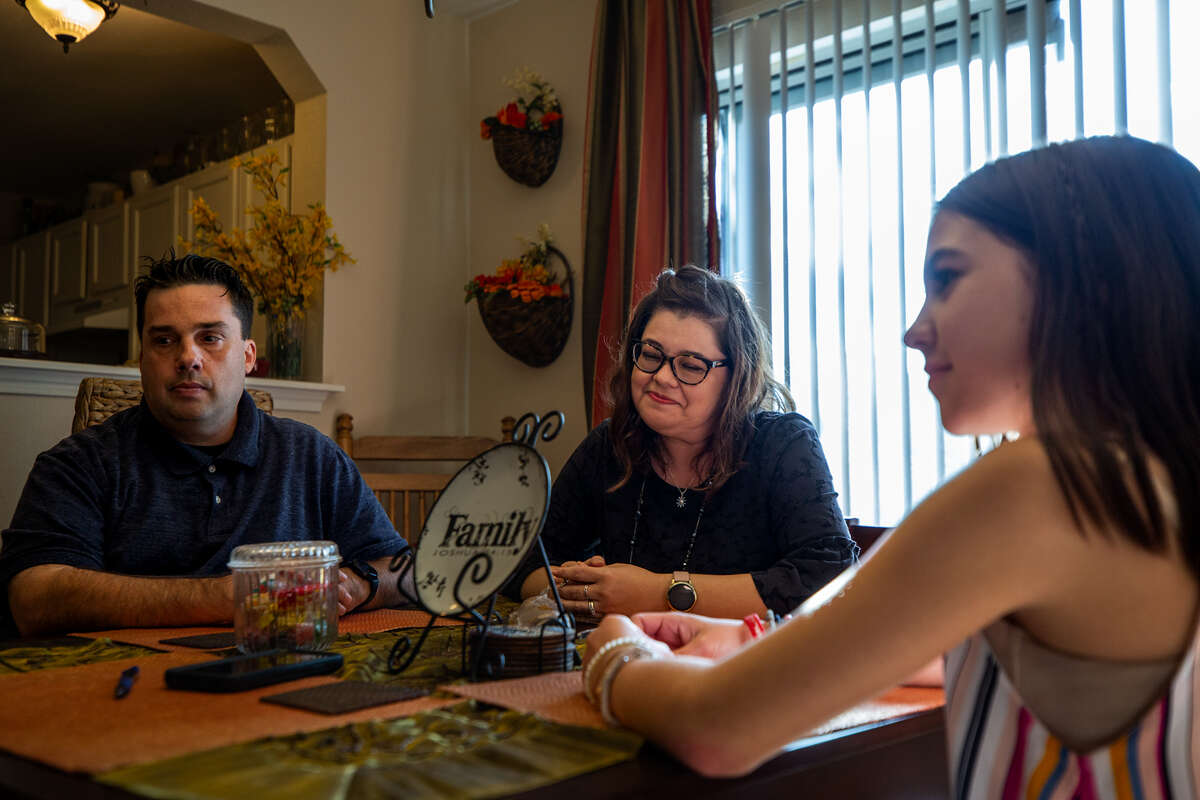
Jason and Laurie Cobb sit with their 12-year-old adopted daughter, Isabella, at their family home in a suburb on the North Side on Sept. 6.
Kaylee Greenlee Beal
San Antonio Express-News
Molly Smith, Vincent T. Davis, Staff writers
Bella Cobb was just a few days old when her biological mother handed her over to a firefighter at the Ladder 49 station on the West Side.
When Laurie and Jason Cobb arrived at the hospital to meet their adoptive daughter, the infant’s name was “Baby Moses.” The couple chose the name Isabella Grace, meaning “beautiful” and “second chance.”
Now a seventh-grader, Bella wasn’t nervous as she shared her story with the mayor and a handful of City Council members and spoke about a topic that’s dear to her — Texas’ Safe Haven law, also known as the “Baby Moses” law. The law allows parents to legally relinquish their unharmed infant up to 60 days old with someone at a fire station, EMS station or hospital.
The babies are taken into Texas Department of Family and Protective Services custody.
“This is going to be an amazing year for me,” Bella, 12, told a council committee on Aug. 30, highlighting her involvement in theater, arts and band, and her love of watching the San Antonio Spurs with her dad.
“I’m hoping my story can help elected officials continue to make decisions that can give other kids the same chance I have been given,” she said.
The North Side family expected the committee to vote on whether to fund the purchase and installation of newborn safety devices at city fire stations. Mayor Ron Nirenberg surprised them when he said, “It’s already moving forward.” The city set aside $438,000 in its new $3.7 billion budget to purchase a dozen devices, commonly known as baby boxes.
San Antonio is poised to become one of the first cities to take advantage of a change in state law that allows parents to safely and anonymously surrender their newborn for adoption using a newborn safety device.
The temperature-controlled boxes are connected to a fire station or hospital, and once closed, a silent alarm alerts staff to the baby inside.
Senate Bill 780
Previously, the Safe Haven law — passed in 1999 — required a face-to-face exchange when a parent relinquished their infant.
That changed with the passage of Senate Bill 780 this spring.
Filed by Sen. José Menéndez, D-San Antonio, and Sen. Bryan Hughes, R-Mineola, one of the Texas Senate’s most conservative members, the bill now allows for the use of newborn safety devices, enabling a more anonymous exchange, supporters said. It had bipartisan support in both chambers of the Texas Legislature, and Gov. Greg Abbott signed it into law in June.
Safe Haven laws have become a key part of the anti-abortion movement. The U.S. Supreme Court cited the laws as an alternative to the procedure when it overturned the constitutional right to an abortion in 2022.
District 9 City Councilman John Courage sees San Antonio’s support for baby boxes as a “a winning situation, whatever side of this concern you may be on.” Courage, a Democrat who has represented the council’s most conservative district since 2017, pushed for the city to throw its weight behind SB 780 and for it to install the devices at city fire stations.
“I think this is a pro-life and a pro-choice situation because it does give a woman a choice of what to do with that child when she’s in crisis, and at the same time, it does protect the life of a child,” said Courage, a potential 2025 mayoral candidate.
Pamela Allen expressed a similar sentiment. She is the founder and chief executive officer of Eagles Flight Advocacy and Outreach, a nonprofit that provides free burials for abandoned babies and children who die from abuse or neglect in Bexar County.
“Whatever side you’re on, I’m not concerned with that,” Allen said. “What I’m concerned with is not finding babies in trash cans. You have to have the vision that these babies have to stop dying.”
Allen, who met the Cobb family through church, said Bella is “proof that this law works.”
Safe Haven law rarely used
The state’s Safe Haven law has been infrequently used, which advocates like Allen chalk up to the lack of state funding to publicize the measure.
Since 2009, 194 infants have been relinquished statewide under the law, including 15 so far this year, according to the Department of Family and Protective Services. County-level data is not available.
Despite this, Courage supports using more than $400,000 in city dollars to bring newborn safety devices to a handful of fire stations.
“If we can keep one child in this city from being abandoned in a dumpster, it’s worth 10 times that amount of money to me,” he said. “And I hope that we’ll find that we’ll positively affect the lives of many children, one way or another.”
As recently as August, a couple left a 1-day-old baby by the back door of Grissom Road Church of Christ on the Northwest Side. The infant, who survived, was discovered almost 20 hours later by a passerby.
Some of the city funding, Courage said, will go toward a city-led educational campaign about the state’s Safe Haven law.
The San Antonio Fire Department is still determining which of its 54 stations to put the 12 baby boxes in, said department spokesman Joe Arrington. There is no timeline for how soon they will be purchased.
“What is key to remember is that all SAFD stations are a Safe Haven location no matter if there is a box there or not,” Arrington said. “That has been and will continue to be the case.”