Killeen: Homeless shelter funding questions reach critical point as specter of closure looms
Published: Sun, 10/01/23
Homeless shelter funding questions reach critical point as specter of closure looms
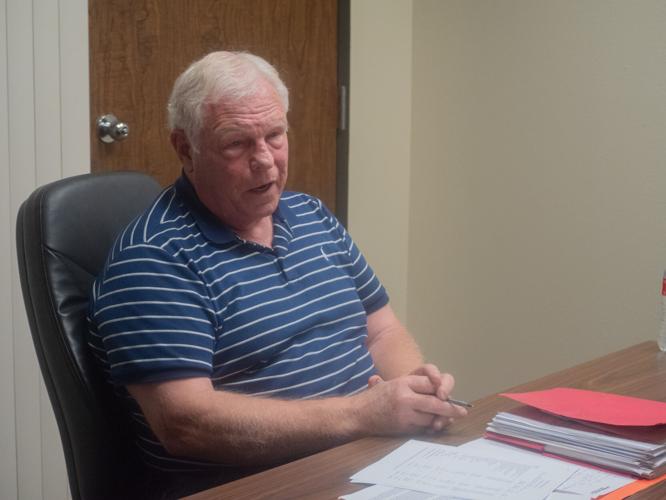
Secretary of the Friends in Crisis board Larry Moehnke at the Killeen Daily Herald facility on Sept 28.
Walter Lanier | Herald
Killeen Daily Herald
By Kevin Limiti | Herald
October 1, 2023
The front row at the Killeen City Council meeting Tuesday night was filled with those who utilized the Friends of Crisis homeless shelter in north Killeen, a shelter that will close in early February if something isn’t done.
Nigel Dunn, a Killeen resident, said he spoke to the board of the organization responsible for the Friends in Crisis homeless shelter — known as Families in Crisis — and said those using the homeless shelter would transition to a new homeless service called Arbor of Hope.
“But they haven’t broken ground yet,” Dunn said.
Arbor of Hope, at the moment, only exists on paper.
Dunn’s presentation was spoken in four minutes — the allotted time any person can be given to speak during a citizen’s petition — and his remarks were punctuated by murmurs of agreement from those in the front row.
The council responded with surprise and some members were defensive in regard to funding the homeless shelter on Sprott Street in north Killeen.
“I don’t think there’s anyone in this room who would disagree about the need that is served by the shelter,” Councilman Ramon Alvarez said.
Alvarez said he had served on numerous nonprofit boards that were similar to Families in Crisis, such as Habitat for Humanity.
“(The) cities are not their main source of funding,” he said.
Friends in Crisis has reached a critical situation, where the shelter is expected to close since federal grants have dried up, leaving people in the 78-bed facility with potentially no recourse when its doors close in late winter.
Should Friends in Crisis close in February as expected, it will not be the first shuttering of the shelter, which opened just before Christmas in 2015.
On May 18, 2019, the shelter suddenly closed for nearly two months, prompting the impromptu creation of a “tent city” on the shelter’s lawn.
At the time, Larry Moehnke, a Families in Crisis board member, said the organization was notified in March 2019 that a $93,500 Emergency Solutions grant would be reduced to $51,273 due to their funding allocations. A second grant for $123,000 was discontinued, according to the financial report.
As a result, the shelter was shuttered and Families in Crisis launched a $200,000 fundraising campaign. The campaign raised several thousand dollars and, coupled with the commitment that grant money would once again become available, the shelter reopened on July 26, 2019.
The Shelter
Moehnke told the Herald in an interview Thursday that back in 2012 and 2013, one of the city of Killeen’s highest priorities was the issue of homelessness.
“They came to us and asked us if we were ... because of our success in working with domestic violence survivors ... if we would consider addressing the homeless issue,” he said.
Eventually, Families in Crisis chose to pursue this because, Moehnke said, it would “be a benefit to a large number of our community members.”
The shelter opened on Dec. 23, 2015, after an effort by then-Mayor Dan Corbin. The facility was renovated from an old church, and the city provided more than $760,000 for construction of the downtown shelter, which had a total cost of $1.4 million.
Families in Crisis funded the remainder, taking out a $250,000 loan in the process.
Moehnke said the operation of the shelter costs approximately $50,000 a month. The facility employs seven paid staff members and also utilizes volunteers.
The sources of the shelter’s funding include grants and donations.
But one of the biggest blows to the homeless shelter’s finances was when the FIC board found out this summer that they were no longer going to receive Temporary Emergency Relief Funds (TERF) from the Bell County Commissioners.
Previously, Families in Crisis had received an estimated $230,000 from TERF. But it received none in 2023.
To make matters worse, the city of Killeen allocated no Community Development Block Grants (CDBG) for the past two years, Moehnke said.
William Hall, director of operations for Families in Crisis, said Thursday in response to the rumor that Families in Crisis was mismanaging its money, that it had done an audit recently that found no red flags.
He also explained the nonprofit’s extensive process of receiving grant money.
“For our federal dollars, we have to give them monthly (reports) towards how many dollars we’re spending, how many people were seeing, some of our reports will ask their ages, their demographics, some want to know how much money we’re spending each household,” Hall said. “In housing suspension — real special — you’ve got to break it down every dollar you spend on every person in their house. So it’s a very intense onboarding.”
He said they have to send a copy of the blank checks, and other processes including how expenses are provided to their funders.
“We have an independent auditor in Waco,” he said, explaining they conduct an audit every year. “And they just finished our audit … and they go through at least … 55 to 60% of our expenses.”
But, whatever happens, Hall doesn’t believe that the homeless shelter should be left to its own devices.
“We opened way back in 2015,” Hall said. “It was the understanding they (the city) want us to take on the mission of a homeless shelter. We had a building. They would help fund us to get the building. We went out, we fundraised over a million dollars and then they put in some money, and we took out a loan for the building for the rest of it. And they would continue funding that in some way for support services.”
Hall said that Killeen city staff had been working with them about the homeless shelter’s challenges over the past few months.
CITY COUNCIL
But the discussion from the City Council had not pivoted toward being solution-driven last week.
“I know they have applied for some CDBG funding, not directly, though,” Alvarez said about Families in Crisis.
Mayor Debbie Nash-King said during Tuesday’s council meeting that the city had not received a formal request for funding Families in Crisis for the shelter.
However, Hall and Moehnke said the shelter’s organization did apply for community block grants with the city, but they were not granted.
Dunn said those funds are now going toward Arbor of Hope.
Arbor of Hope is a nonprofit organization servicing the homeless community. It began in the city of Temple. Its current status in Killeen was questionable as of Friday.
Alvarez suggested that Families in Crisis should come before the council.
“Lots of nonprofits in the city are very worthwhile,” he said. “Unfortunately, that’s not one of those things realistically where a city can fund all these different missions. I wish we could, but taxpayers probably wouldn’t like what that tax rate would look like.”
Councilwoman Jessica Gonzalez, who represents downtown and north Killeen, said she had “concern and pause” over why the closing of the shelter was not presented in a formal manner to the council.
Councilman Jose Segarra said that the city of Killeen helped get the shelter started, but wasn’t obligated to fund it continuously.
“I know we had like two years, two cycles of CDBG grant money that we set aside to make sure they got that initial funding that they needed to get started, just like we are trying to do with Arbor of Hope,” he said. “It was up to them to just keep that funding and I think every year they do ask, as somebody mentioned part of our CDBG ....”
Segarra also brought up the last time the homeless shelter ran out of money and there were people sleeping outside the homeless shelter in 2019.
“We don’t want to keep doing this every three or four years,” Segarra said. “We have to have something that is going to keep them sustained through the long term and I know that’s a challenge.”
Former Councilwoman Mellisa Brown said during citizen comments Tuesday that the city had not provided funding through CDBG grants for the past four years.
“There are two separate programs that we need to remember ... We have redirected money to Arbor of Hope — actually $2 million set aside right now out of our general fund for Arbor of Hope,” Brown said, complaining about the city council’s perceived lack of knowledge about the issue.
“That implication is so far out of this world that I can’t even comprehend why it’s something that’s coming up,” Brown said. “This is not the first time that has happened. And prior to this, the city was providing some funding. Even if it’s going to administrative costs to help pay for a salary for a person, that’s $30,000 less that has come out of operations to assist the homeless.”
‘Big mistake’
Don Smith, a Killeen resident who spoke at Tuesday’s meeting, said it would be a “big mistake” to close the homeless shelter.
“My fear is if we close that shelter, that situation is going to get worse,” he said, in regards to the homeless issue.
He also asserted that the reason the downtown H-E-B, which closed in 2019, shuttered its doors in the first place was partly due to homeless people harassing customers.
“I just want to make it abundantly clear that I completely agree with the sentiment here,” Gonzalez said. “I appreciate the energy here, but my challenge is …the source. Friends in Crisis are responsible. It’s their mission and their vision.”
Nash-King said the $30,000 needed to help pay for a staff member of Friends in Crisis was a “drop in the bucket.”
“What’s going to happen the rest of the year? It’s bigger than us giving $30,000,” she said. “A lot of things will be said against this council, but it’s not our fault. What we have to do is work together for a solution because no one should be without a place to stay.
“And it breaks my heart because the individuals that live in the shelter are here, but I don’t see the board,” Nash-King said.
ARBOR OF HOPE
In February, the city of Killeen approved its plan for dealing with homelessness, much of it involving Arbor of Hope, which provides “transformative” housing for those experiencing homelessness.
At the time, then-Assistant City Manager Danielle Singh said the plan was part of a strategy on how to move forward with any services related to homelessness.
“The point of the Arbor of Hope would be to bring those nonprofits together. It’s more of a united organization to use those resources we already have,” she said.
On Thursday, Nash-King said in an email that Temple had pulled out of a the countywide agreement on Arbor of Hope.
On Friday, she released a new statement clarifying her previous one:
“The City of Killeen is on track with the Homeless and Mental Health Strategic Plan as presented to Council. This includes the set aside of funds for the construction of the multiplex with transitional housing, as well as starting the hiring process for a Licensed Master Social Worker.
“As we progress in the implementation of the plan, we do anticipate there may be a need to refine our approach to ensure that the services needed to address homelessness and mental health in our community are delivered with the intent to maximize optimum, long-term success.
“The City anticipates that there may be some changes, including a renaming and restructuring of the Arbor of Hope Campus. It is my hope that in the future, the City would be able to continue to coordinate our efforts with Temple and Bell County.”
Bell County Judge David Blackburn said Friday there never was a countywide agreement. It was just something that was being talked about.
William Hall, director of operations for Families in Crisis, said Thursday he spoke with Robert Marbut Jr., a San Antonio consultant who was working with Killeen and Temple to create Arbor of Hope.
Hall said Marbut came to their office and talked to him about shelters. They gave him data on the shelters they operated, how many people they served—in both the homeless shelter and the domestic violence shelter.
“And I told him at the time — and this was at the front end of this — that we were just told about these meetings the day it happened and this is not how we’re going to get anything done,” Hall said.
Hall said Marbut told him that he did not have any “big players” including the Salvation Army, Families in Crisis, Endeavor and others that would be involved in his plan for Arbor of Hope.
“The next time we heard anything else about it — we were not in any of these meetings — was when Dr. Marbut was telling both the Temple City Council and the Killeen City Council that to make this work, the Friends in Crisis (shelter) would have to be eliminated in downtown.”
Hall said from his understanding, Marbut’s reasoning was to consolidate the efforts.
“They would move everything to Arbor of Hope and they would be able to handle it all; and it would put all the homeless in one location,” Hall said.
Hall said that should the shelter close down as a headquarters for carrying out its mission of helping the homeless, he wanted to make sure that the clients would still be taken care of.
“We said, ‘We need to know what’s going on; we need to know a timeline and how this affects Families in Crisis and how it affects the city,’” Hall said. “If we’re going to go down and eliminate this service, we don’t want a gap in this. We want to make sure it’s seamless and it doesn’t hurt the clientele that we’re helping. We never got an answer.”
Councilman Riakos Adams said in an email to the Herald Thursday the Arbor of Hope was “still in its infancy.”
“The partner municipalities (Killeen, Temple, and Bell County) appointed members to the Board and the Board was to proceed with their organization process. The City provided initial support in this process. I do not see them on the IRS 501c3 list yet. I haven’t checked the Texas Secretary of State listing. I have requested an update,” Adams said. “Earlier in the year, the Council approved a motion of direction to set aside 2 million dollars to support Arbors of Hope. I voted no because I didn’t think there was an extensive enough cost-benefit analysis to justify the amount and I believed there were other programs that would benefit leading up to the opening of the Arbor of Hope.”
A motion of direction is not binding; a formal vote would be required in order to allocate the money.
“CDBG funds have been allocated to support the Arbors of Hope. I think some of those funds could potentially be used to assist in a transition process to maintain a shelter until the Arbor of Hope Campus is built.
“The city should be engaged in active dialogue to prevent the closure (of the shelter). Financial or logistical support could be considered to keep the facility operational,” Adams said.
“If the Boards of Families in Crisis and Arbor of Hope come together and agree to a merger, or any and all organizations form a coalition, it would be a major step towards helping us address the problem,” Adams wrote.
Ultimately, he said, the Killeen City Council would need to ground its approach on dealing with homelessness to address underlying issues such as low-income housing, the job market and health services.
‘Undeniably Challenging’
Segarra said the amount of money Families in Crisis requested for the CDBG would not have been enough to cover the amount needed to keep the shelter open.
“This situation is undeniably challenging, and it is essential to consider alternative methods to secure the necessary funding for the shelter’s long-term sustainability,” Segarra said. “Otherwise, we risk facing the same predicament year after year. It may be prudent to explore various avenues for raising the required funds, such as fundraising campaigns, partnerships with local businesses, or grant applications from other sources.”
Nash-King sent an email late Friday afternoon clarifying her position on keeping the homeless shelter open.
“The City of Killeen has an interest in ensuring that the services provided the Friends In Crisis program continues without interruption. Staff will explore the availability of certain federal funds over the next several weeks so that the Mayor and City Council can decide the how and if the city can assist the organization,” she said.
Nash-King said establishing Arbor of Hope has been a priority.
“The city has taken steps and is currently on track with implementation of the Homeless and Mental-Health Strategic Plan,” she said. “As the city proceeds with implementation, there may be a need to pivot and refine the plan to ensure that it is as impactful and successful as planned. This could include a name change and/or a restructuring of the organizational strategy. It is still very early in the process but, we remain committed to the initiative to reduce homelessness in our community.”
Arbor of Hope is also being established in the city of Temple, just not as the initial intercity partnership originally planned.
“And the city of Temple is funding the heck out of it,” Hall said Thursday.
A Temple spokesperson said the city of Temple is about two years away from Arbor of Hope being completed.
The plan, Charlese Butler said, is to create housing for 300 people as well as supportive services.
POSSIBILITIES
While it is a possibility that the Friends in Crisis shelter on Sprott Street could close, it is not a foregone conclusion. Officials of the organization say they are doing what they can to keep the doors open.
“There are plans in place that are developing daily as far as addressing if we do have to close,” Moehnke said. “And we are working with city staff. We don’t go outside and just garner city council (support); we’re working with city staff members the proper way of trying to get assistance — and we are being heard.”
Moehnke said they would still use the building, even if the shelter does close.
“If we are forced to close, then we will repurpose that building and we will continue to pay until we pay the loan off,” he said.
Hall concurred.
“We will not just leave an empty building. We will turn that into one of our other programs,” Hall said.
The total renovation costs of the building, which Families in Crisis owns, included procurement of a $250,000 loan, which the organization still owes around $100,000.
Adams in an email Thursday said the closing of the Friends in Crisis shelter was a “matter of great concern.”
“The city should be engaged in active dialogue to prevent the closure. Financial or logistical support could be considered to keep the facility operational,” Adams said.
Suzanne Armour, director of programs for Families in Crisis, said Thursday that homeless shelters that have city involvement, where they are funded as an obligation, are “typically successful.”
Moehnke concurred. “There’s plenty of proof for it,” he said.
“Houston, Dallas ... Austin is working on a big thing,” Hall said. “They have city involvement and send city funding. The funded high levels. And Temple is heading that way, where they’re saying they’re going to fund that shelter. We will go after the federal funding, but we’re not going to have these shortfalls.”
Hall said the problem is that the city has looked at “services vs. taxes vs. everything else.”
He said as of right now, Families in Crisis has no reserves that it can use to keep the homeless shelter open past February.
“There’s no funding now for the shelter this month, except reserves,” he said.