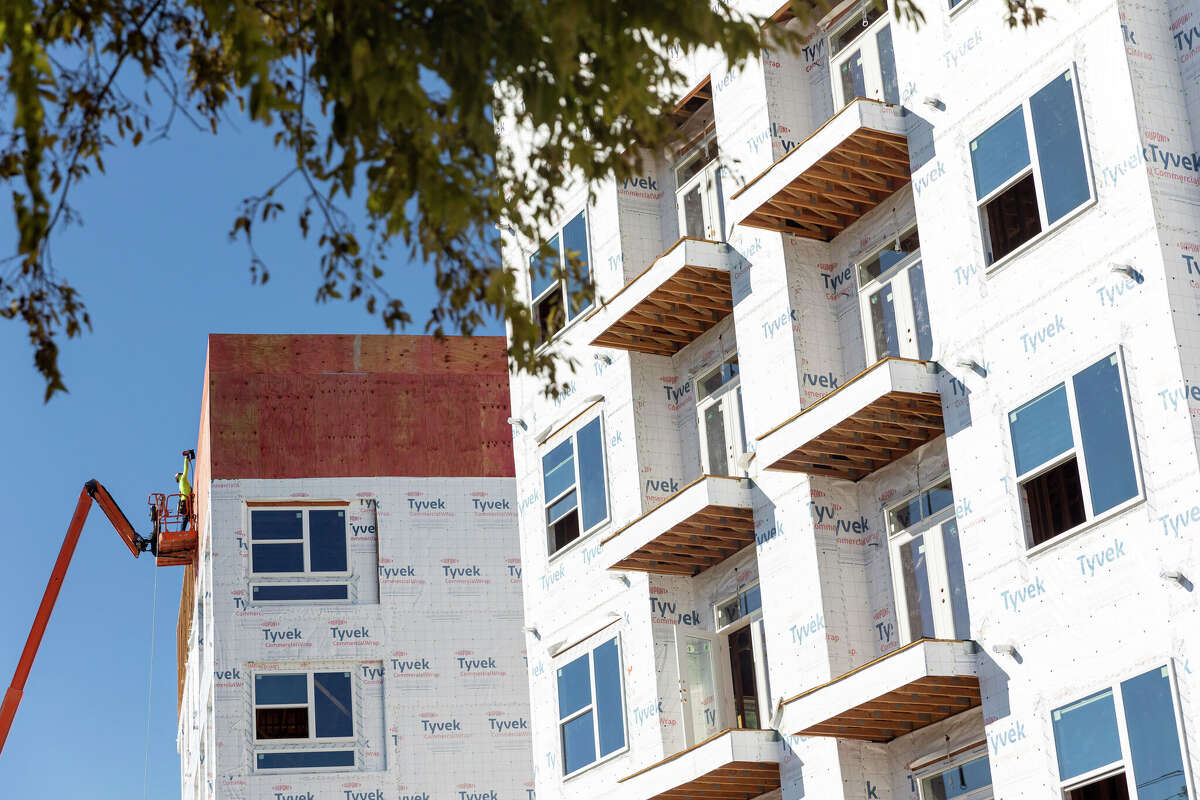
An apartment complex under construction in the Government Hill neighborhood a year ago. Apartment construction in the city lags other major metros, a new study says, and has yet to top pre-pandemic levels.
Josie Norris/Staff photographer
San Antonio Express News
Richard Webner, Contributor
San Antonio, suffering from a prolonged housing shortage, ranks far below other major Texas cities in the number of apartments built in the wake of the COVID-19 pandemic, a new study shows. And as U.S. apartment construction heads toward a record high in 2023, San Antonio construction has yet to top pre-pandemic levels.
Between 2020 and 2022, 18,871 new apartments were finished in the San Antonio metro area — the 19th-highest number among U.S. metros, according to RentCafe, an apartment listing website. The Dallas metro was in the top spot with 76,660, followed by New York City with 66,070, Houston with 53,741, and Austin with 45,051.
By the end of this year, 5,154 new apartments are set to be built in the San Antonio metro, according to the study — up from 4,871 last year but down from 6,763 in 2021 and 7,237 in 2020.
Nationwide, about 1.2 million apartments have been built in the past three years in what the study calls a “pandemic building boom.” Another 460,860 will be completed this year, topping the previous record of 439,000 built in 2021.
“Households grew at a rapid rate after the pandemic as job growth boomed and young adults moved out of their parents’ homes,” the study says. Meanwhile, a trend of working from home led Americans to seek new housing with more space.
In the Austin metro, developers will complete 23,434 new apartments by the end of this year — not far behind the Dallas metro, with 23,659. The study notes that even Dallas’s high number isn’t enough to satisfy the area’s high demand.
In San Antonio — as in many other U.S. cities, especially in the Sun Belt — developers have struggled for years to build enough housing to satisfy high demand sparked by the area’s fast-growing population.
The proliferation of new apartments isn’t evenly distributed across the U.S., the study says; nearly two-thirds of the apartments built in the wake of the pandemic have been in 20 high-growth metros that include only 41 percent of the nation’s total renter population.
“Therefore, for many other places, the new supply barely made a dent in the existing supply,” the study says.
The study also notes that about 89 percent of the apartments finished in the past three years are high-end units with rents geared toward upper middle class and high-income renters.
It’s likely that fewer apartments will be built in coming years as banks tighten lending standards and costs of construction materials and labor rise, Doug Ressler, a senior analyst at Yardi Matrix, an asset management tool that supplied the study’s data, said in a statement.
He noted that construction debt carries interest rates of 8 percent or higher and most banks only lend 60 percent or less of the cost of a multifamily project.
The study predicts that the number of new apartments finished nationwide will drop from 484,000 in 2024 to 408,000 in 2025.
“This financing structure can make it challenging for companies to initiate new construction projects unless they already have a substantial amount of capital on hand,” he said.