Quiet Zone back on Gainesville council agenda
Published: Mon, 10/02/23
Quiet Zone back on Gainesville council agenda
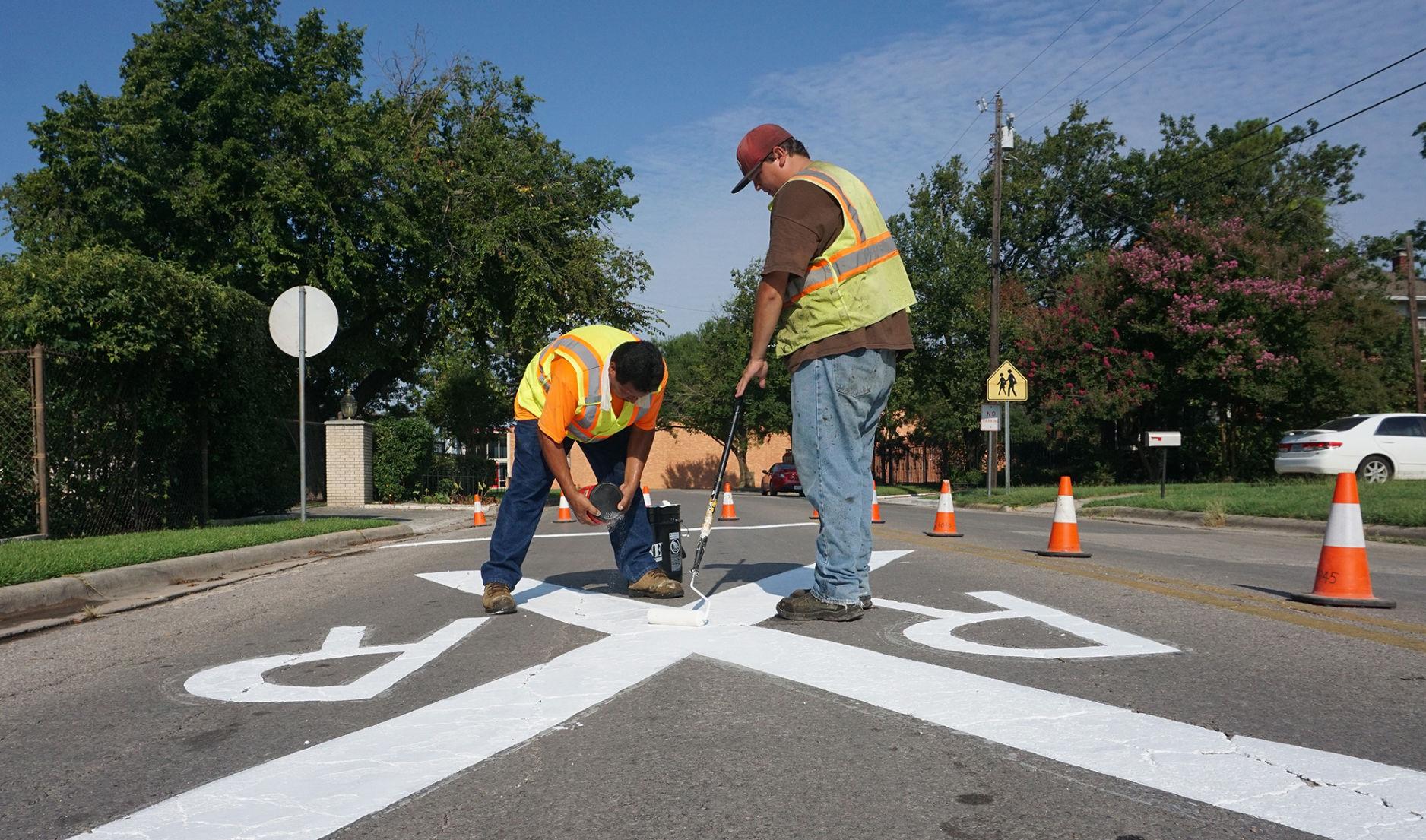
Alex Gonzales dusts fresh road paint with crushed glass specks as he and Jacob Kittrell repaint the railroad crossing marks at the Moss Street crossing just west of Lindsay Street on Tuesday, Aug. 6. The Gainesville city street workers estimated they’d spend a few days freshening up the markings at eight railroad crossings across Gainesville. The glass dust makes the street markings reflective, Gonzales explained.
Sarah Einselen/Gainesville Daily Register
Gainesville Daily Register
ANNA BEALL Staff Writer
October 2, 2023
The possibility of a Quiet Zone for Gainesville’s BNSF rail line is back on the table.
The agenda for Tuesday evening’s City Council meeting includes discussion on a possible design for Quiet Zone Railroad Crossings to be paid for from private individuals. This Quiet Zone would have alternative safety measures in place for railroad crossings and trains would not blow their whistle when coming through Gainesville.
The idea of a quiet zone was brought up last year, and a proposal for $2.8 million in bonds to establish the zone was voted down at the Nov. 8 election. Alternative ideas appeared soon after the election involving private individuals paying for the quiet zone instead of needing a tax increase. One of these plans is being presented at the next Tuesday meeting.
“We have a group of private people who would like to pay for a quiet zone, and they think they can do it, I think, in the neighborhood of $250K or so,” said City Manager Barry Sullivan. “It’s different from what our engineers showed us … so we’re going to give the council time to look at this and discuss it to see if they want staff to move forward with it.”
The previous election totaled 829 For and 2,656 Against. This means a little over 23 percent of voters were in favor of the quiet zone.
According to Randy Jones, who presented an alternative way of achieving the quiet zone on Nov. 15 of last year, people were opposed to the tax increase, but not the quiet zone.
“Not many told me why or how they voted, but a lot of people said that they planned to vote against it, and the few people that I heard about who had expressed an objection, I went to them and said, ‘I understand you don’t want this to happen; why do you not want this to happen? Is it that you don’t want the quiet zone? Or is it that you don’t want to spend $2.8 million and borrow money?’” explained Jones at that meeting. “Every one of them said, ‘It’s not the quiet zone I don’t want; it’s the taxes.”
Leading up to the election, concerns caused heated discussions, both in-person at places like local churches and around the Gainesville Junior High School, and on local Facebook pages like Prosperity for Gainesville and Gainesville, TX Chatter. Many of the documented discussions have little to do with the taxes and more to do with safety risks, closing crossings and whether the noise is as disturbing as some claim it is and if a quiet zone would actually fix it.
Tax Abatements
Guidelines and criteria for granting a Tax Abatement in a Reinvestment Zone are being analyzed before renewal.
These guidelines must be voted on every two years to allow the city to grant tax abatements to businesses. This means that the business pays a lower tax than would be typical for the value of their property. Cities like Gainesville often use these abatements to attract new businesses and industries to them.
The council will have an option for the criteria to stay the same with a flat rate. There is also a new option being presented to give businesses a larger tax cut up front that decreases over time.
“I put the exact same thing in front of [the council] … in the past we’ve don’t like 70 percent straight across the board,” said Sullivan. “Then I gave them an option in the communique that says some cities have super 90% abatements, but they don’t usually last but a year or two … so they can give a bigger one for a couple years then drop it down to 70 percent for so many years and then down to 50 percent. A lot of times it works out about the same … but they get more upfront when they need the money … that’s going to be an option for them to add.”