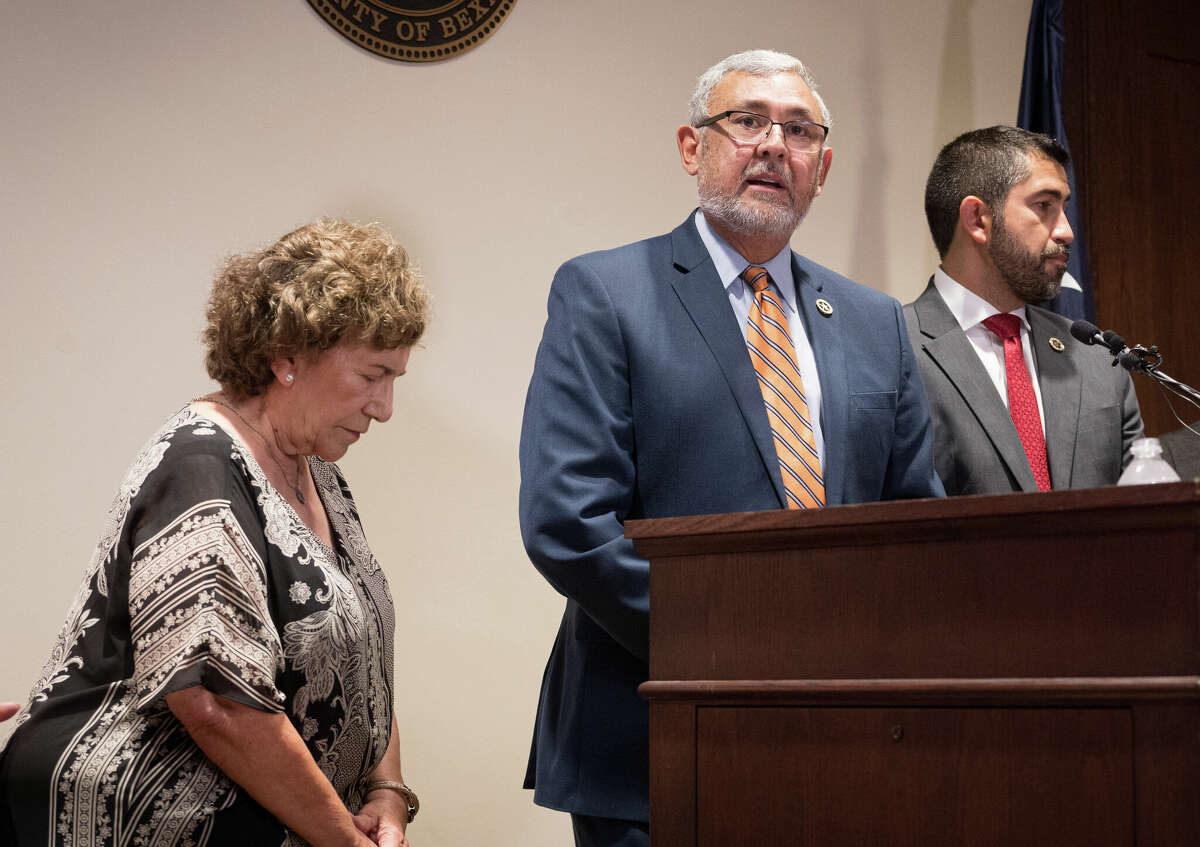
Juanita "Janie" Najera, 75, bows her head and trembles with emotion as Bexar County District Attorney Joe Gonzales announces that a grand jury indicted the owners of the dogs that killed her husband, Air Force veteran Ramon Najera Jr., 81, on Feb. 24 on San Antonio's West Side.
San Antonio Express-News
Peggy O’Hare, Staff writer
Two state legislators from San Antonio have refiled the Ramon Najera Act, a bill that would toughen criminal penalties for owners of vicious dogs and shield the names of people who report the animals to authorities.
The legislation passed the Texas House and Senate in May, but Gov. Greg Abbott vetoed it in June, calling it heavy-handed and unnecessary. So its sponsors are trying again.
State Rep. Liz Campos and state Sen. José Menéndez, both Democrats, resubmitted the bill after the Legislature’s latest special session began Monday.
The legislation is named for Air Force veteran Ramon Najera Jr., 81, who was killed by strangers’ dogs that escaped their fenced yard on San Antonio’s West Side on Feb. 24. The dogs also attacked his wife, Juanita “Janie” Najera, 75, who survived. The animals bit a San Antonio Fire Department captain and a bystander who were trying to stop the mauling.
The dogs’ owners, Christian Alexander Moreno and his wife, Abilene Schnieder, both 31, are charged with two felonies: dangerous dog attack causing death and recklessly causing injury to an elderly person.
Campos said Tuesday that the legislation is “much needed.”
The lawmaker said she wants to give San Antonio Animal Care Services greater latitude to seize dogs that have attacked or menaced bystanders or neighbors.
Campos said her bill also seeks to keep confidential the names of people complaining about dangerous dogs so they can do so without fear of retaliation.
“There’s too many dogs out there that are biting innocent people,” Campos said. “We need to make sure our communities are safe … We need to protect our communities, especially the elderly.”
The proposed law would take effect only in San Antonio because officials in rural areas expressed opposition to it, Campos said.
The bill will apply only in a municipality that contains more than 70 percent of the population in a county with at least 1.5 million residents.
“In order to make this palatable and passable, we had to limit it to Bexar County,” Menéndez said. “Houston and Dallas didn’t want to be a part of it. And we said, ‘Fine, we’ll make it Bexar County alone, because we need the help.’”
The proposed law “makes it easier for ACS to potentially pick up a dangerous dog, get the dangerous dog out of the neighborhood or out of the situation,” he said. “We’re not looking to euthanize more animals. We are looking to keep neighbors safe.”
Campos and Menéndez have added a new provision intended to hold dog owners accountable for less severe attacks.
The bill states that a dog owner commits a criminal offense if they fail to secure a dog and it makes an unprovoked attack that causes a bodily injury, a serious bodily injury or death.
Under the bill, a dog attack that causes a non-serious injury is a Class B misdemeanor, compared with Class C under current law.
The measure defines an attack causing serious bodily injury as a third-degree felony and an attack causing death as a second-degree felony.
It also stiffens penalties for repeat offenders.
Campos said the bill will encourage responsible dog ownership.
“We look forward to passing it one more time in the Texas Legislature and have started conversations with the governor to ensure that he is engaged early in the process and signs this particularly important legislation into law,” she said.
Menéndez said he hopes the bill will receive support from state leaders.
“The Najera family and our community deserve to have a safe neighborhood with appropriate policies to anonymously report a dangerous dog,” he said.
Najera and his wife had driven to a friend’s home in the 2800 block of Depla Street on the day Najera was killed. Moreno and Schnieder’s three dogs escaped their fenced yard next door, and two of the animals attacked the Najeras while they were on their friend’s property.
One of the dogs tore off parts of Najera’s clothes, inflicted deep bites and tore a dialysis shunt from his body as he yelled for help.
His widow suffered severe lacerations to her right leg.
All three of Moreno and Schnieder’s dogs were euthanized.
A second San Antonio man died on Oct. 1 from complications of a separate dog attack. Paul Anthony Striegl Jr., 47, was severely mauled by a next-door neighbor’s dog on Sept. 5. The animal crawled under a fence to reach him at a trailer park in the 9500 block of Heidelberg Street on the Northeast Side.
A police report said that both of Striegl’s arms were “destroyed” by dog bites. Large sections of skin were ripped from his abdomen.
In that case, Animal Care Services issued three criminal citations to the dog’s owner, who was at work at the time of the incident and who said his girlfriend’s mother let the dogs outside without his knowledge. No further charges are expected in that case.
The dog that attacked Striegl was euthanized.