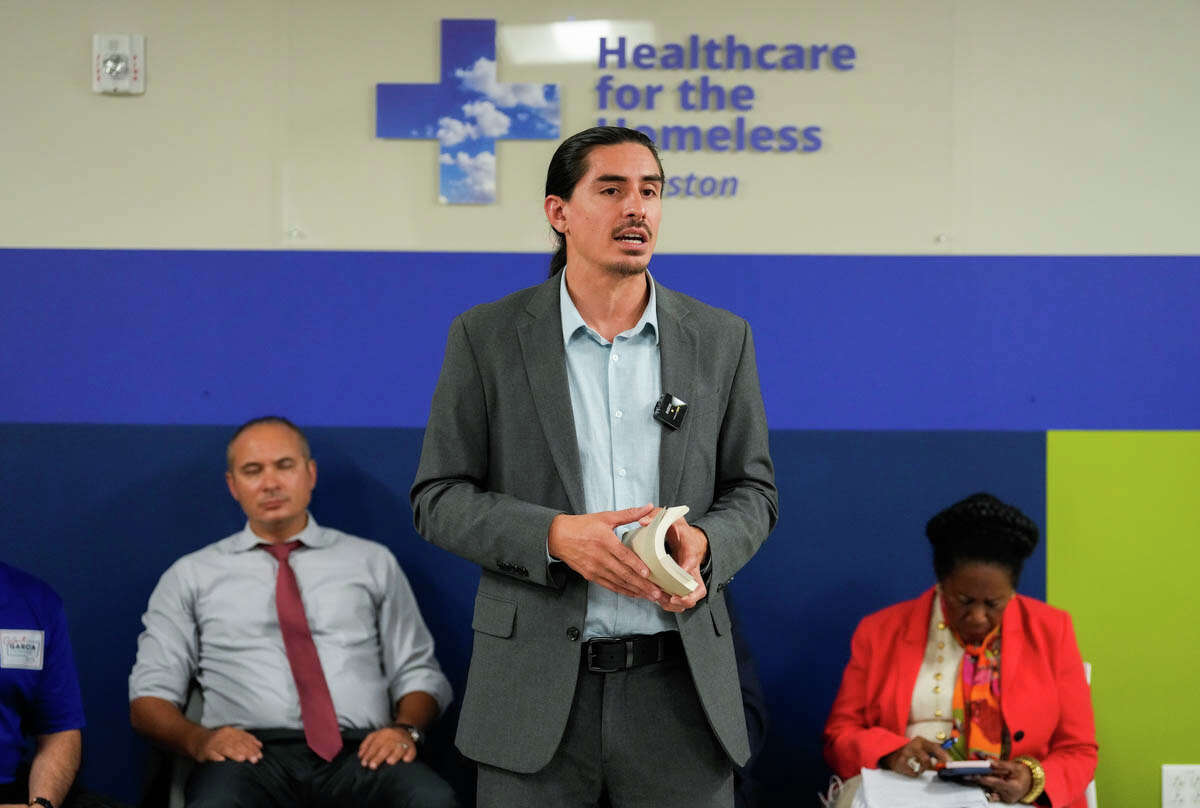
Mayoral candidate Derrick Broze speaks at a forum hosted by Healthcare for the Homeless for mayoral candidates to speak on their positions on homelessness on Thursday, Aug. 17, 2023, in Houston.
Raquel Natalicchio/Staff photographer
Houston Chronicle
Yilun Cheng
Derrick Broze, barred from the upcoming mayoral election because of a two-decades-old felony conviction, sued the state of Texas, arguing its election law is unconstitutional.
Broze, a 38-year-old independent journalist and activist, started campaigning for City Hall’s top job at the beginning of 2023. In June, the city denied his application to get on the ballot after he self-reported a previous felony record.
In the complaint filed Monday, Broze contended the Texas Election Code's eligibility rules against all candidates with unresolved felony records are too restrictive. In contrast, he said, the state constitution only excludes individuals convicted of “high crimes'' such as bribery, perjury and forgery from holding office.
Broze was convicted of felony drug possession in 2005 when he was 20 years old. A judge gave him two years of probation at the time. He violated parole and was then sentenced to two years in prison.
He was struggling with drug addiction and depression during those years, Broze said, but he has since rebuilt his life and focused on community activism around civil liberties, environmental protection, homelessness and other causes.
His non-violent drug conviction, Broze argued, does not fit the criteria of a “high crime.” The denial of his ballot application stands as a demoralizing reminder that, even after nearly two decades, he still cannot fully participate in society, he said.
“I did my time, paid my debt to society,” Broze told the Chronicle. “Being blocked from the ballot because of having a felony in Texas is just another barrier to entry that felons like myself have to face.”
Lawsuit rekindles longstanding debates
The state election code specifies that candidates must not have been "finally convicted of a felony" unless they have been pardoned or "released from resulting disabilities."
Past candidates have argued that completing probation equates to being released from such disabilities. But an opinion from Attorney General Ken Paxton's office asserts that such a candidate would need a pardon, judicial clemency or a writ of habeas corpus invalidating the conviction.
Despite legal uncertainties, a number of past contenders with felony records have appeared on ballots in Texas cities. Broze himself ran in the 2019 Houston mayoral election and received about 680 votes. At the time, he signed a city form claiming he was eligible, later citing his belief that the ban no longer applied to him because he had finished his sentence.
Since then, a new state law has come into effect, now requiring candidates to provide proof of their eligibility. Broze was disqualified in June after checking a box that acknowledged his previous felony record. Meanwhile, J. Brad Batteau, a city council candidate with an armed robbery conviction from 1987, did not check the box and was allowed on the ballot.
City Attorney Arturo Michel said the city rejected Broze's application based on the amended state law and the attorney general’s opinion. He previously told the Chronicle the city does not “go beyond the check mark on the ballot application."
“The City of Houston has abided by a good faith belief in the current state of the law and will follow future, binding interpretations,” Michel said in a statement Wednesday.
In the newly filed complaint, Broze also criticized the existing system for applying for and granting restoration of civil rights. He claimed it operates without clear rules and relies solely on the discretion of the governor and the Texas Board of Pardons and Paroles.
The Office of the Attorney General has not responded to requests to comment on Broze’s lawsuit.
Case likely be an uphill battle, Broze said
Gerald Birnberg, a constitutional law attorney and ex-chair of the Harris County Democratic Party, said Broze’s case could have far-reaching legal impacts since many points in his lawsuit have not been fully litigated in court.
He agreed with Broze's argument that his drug conviction should not count as a "high crime" since it does not involve dishonesty, unlike other listed offenses. However, this does not necessarily mean the state constitution prohibits additional laws that extend beyond its specified crimes, Birnberg said.
“At least we could add some clarity to the Texas Election Code,” Birnberg said. “I also believe that we would be well served to have people who have been through that experience as an elected office. That perspective can teach us what it takes to rehabilitate people.”
Broze acknowledged that the case will likely be an uphill battle and may require a Supreme Court decision to effect the change he envisions. He said he has crowd-funded his legal fees, raising about $5,000 as of Wednesday, but he anticipates needing an additional $10,000 to $15,000.
Meanwhile, he continues to go to election events to advocate for other local initiatives that align with his values, including Proposition A. Many attendees have approached him at these events to inquire about his efforts to challenge the Texas Election Code, he said.
“Me being rejected from the ballot in some way generated more attention to this particular issue,” Broze said. “Even if we don't win, maybe we can generate a conversation.”