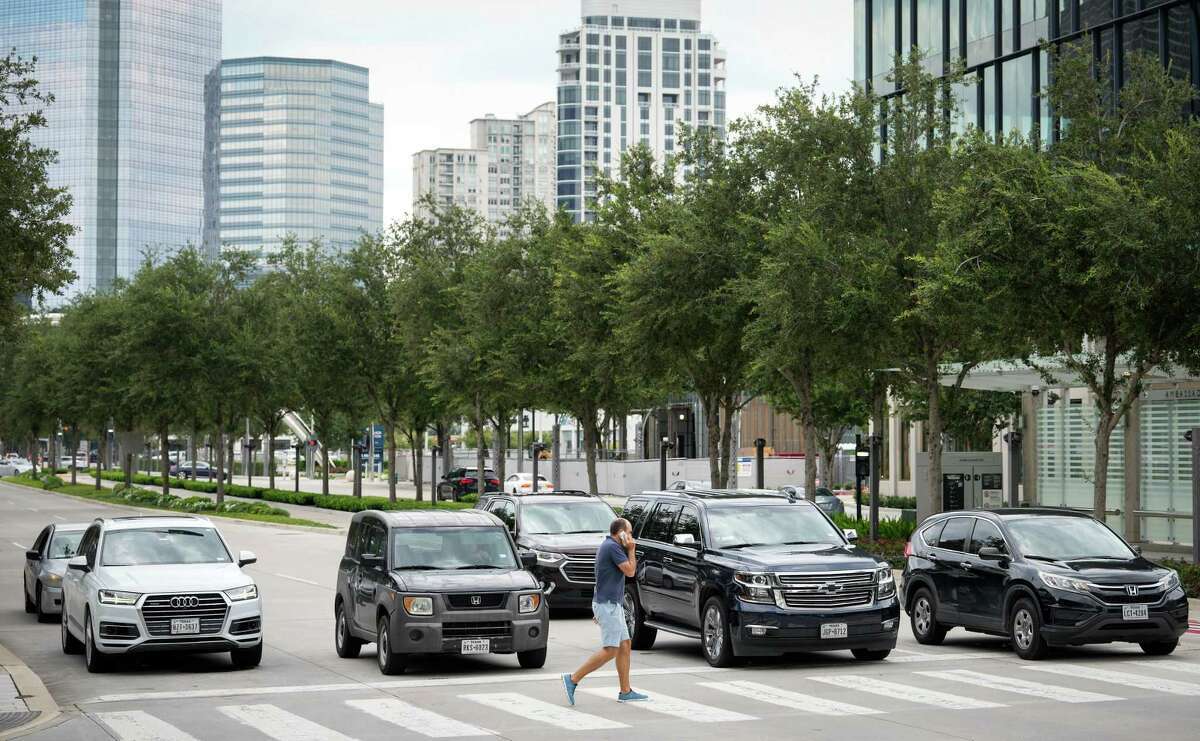
A man crosses Post Oak Boulevard in Houston's Uptown TIRZ, the wealthiest development zone in Texas.
Jon Shapley/Staff photographer
Houston Chronicle
Yilun Cheng, Mike Morris, Staff writers
City Council has delayed for a second time a vote on Houston’s first-ever framework on Tax Increment Reinvestment Zones because Mayor Sylvester Turner’s staff declined to release a white paper explaining the new rules in detail, saying the document is incomplete.
A Tax Increment Reinvestment Zone, known as a TIRZ, is an area where property tax revenue generated from improvements and developments is used to fund public utilities within its boundaries, rather than being sent to the city’s general fund. The controversial program now claims nearly $200 million in city revenue each year.
Despite hosting Texas’ largest TIRZ system, Houston has never set clear guidelines on the program, leading to cases where funds are directed to affluent communities while underdeveloped areas suffer, a Houston Chronicle investigation found. To address the lack of binding rules, Turner’s administration developed the city’s first guidelines on how to create, grow and terminate TIRZs.
In May, officials from the Mayor’s Office of Economic Development touted their comprehensive research on the topic to the City Council and a 34-page policy document spelling out the details. They included the white paper’s table of contents in their presentation and offered to sit down with any interested council member to review the larger document. But when a council member followed up, she was told it wasn’t ready.
Two and a half months later, all that the council members and the public have seen is a two-page summary. The Mayor’s Office of Economic Development has declined to circulate even a draft. Five council members tagged the proposed framework last week and District J Councilmember Edward Pollard on Wednesday moved to delay it, again, until the end of August.
“We don’t have to get into the supreme details of every little procedure of the ordinance,” Pollard said. “But the big questions regarding the TIRZs — creations, terminations, community feedback, timelines — those are things that we should have engagement within.”
Turner said he hasn’t seen the larger policy document, either, and can’t promise when it will be available for review. He suggested the council consider only the two-page proposed framework. Many council members, however, expressed frustration with the unfulfilled promise.
“Twenty-five percent of our taxable value is tied up in these TIRZs,” said At-large Councilmember Sallie Alcorn, who has worked on the project with city staff and tried to accept the invitation to review the whole policy after the May meeting. “I’d like to see what’s in that document. … I think that’s not an unreasonable request.”
Chief Development Officer Andy Icken said the document should be finished by the time the annual budgets for each zone are presented to the council this fall.
Rules could impact Galleria-area TIRZ
While detailed analysis on the city’s various TIRZs are yet to be released, the most immediate impact of the proposed framework might be the future of Texas’ most prosperous zone: Uptown. Formed in 1999 around the Galleria mall, the zone encompassed nearly $2 billion in land value at the time.
Uptown, having arguably accomplished its mission, may enter “pre-termination” mode, paying off its obligations rather than taking on new projects, according to Icken and Gwendolyn Tillotson, deputy director of the Mayor’s Office of Economic Development.
However, they said, it might be best not to terminate Uptown but to have it annex neighboring Gulfton, a neighborhood with no shortage of infrastructure needs. That way, they said, there would be more money available for projects in Gulfton immediately, as compared to forming a new zone in that neighborhood and waiting decades for it to generate revenue.
The disparities between Uptown and Gulfton were the focus of the Chronicle’s TIRZ investigation last fall. Officials with the Uptown zone deferred questions on the topic to the Turner administration.
Sandra Rodriguez, president of the Gulfton Super Neighborhood Council, said being part of a TIRZ would help her community tackle needed street and drainage improvements. Deteriorated sidewalks near Burnett Bayland Park, she said, also are of concern for residents.
“All these initiatives have come up throughout the past few years, so we have projects ready to go. We just need the funding,” Rodriguez said. “If we have a TIRZ or another bucket of money, we can make these projects a reality within a few years.”
But Rodriguez said she would prefer Gulfton to have its own TIRZ instead of being grouped with Uptown, in order to preserve her neighborhood’s unique character and keep its future in the hands of Gulfton residents.
“Uptown is more of a business corridor. Gulfton has businesses, too, but they’re incorporated into the thread of our residential community. We could be at risk of gentrification,” Rodriguez said. “The Gulfton community, residents and business owners need to be at the table having these conversations before a decision is made.”