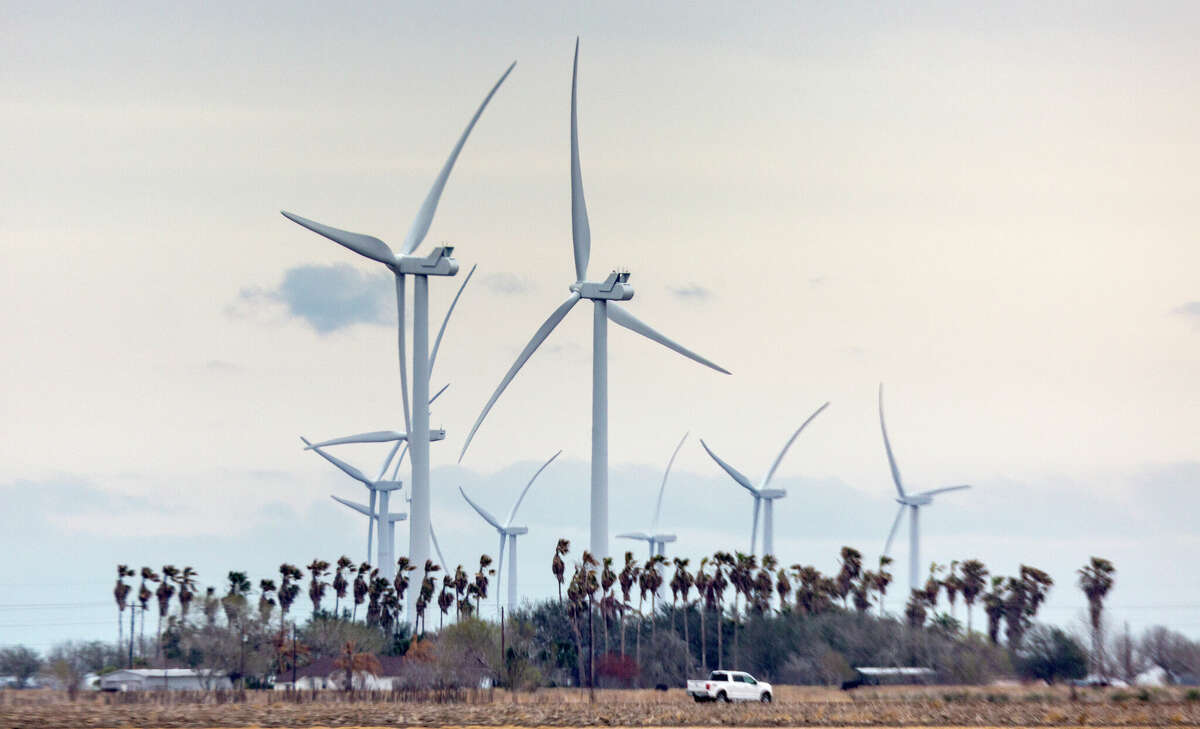
Wind turbines like these near Raymondville in the Rio Grande Valley were producing power Wednesday, grid experts say, but the state’s power grid couldn’t get it to where it was needed.
William Luther
San Antonio Express-News
Sara DiNatale, Staff writer
The Electric Reliability Council of Texas said late Thursday that speculation a gas- or coal-fired power plant tripped offline was incorrect. Rather, it pointed to what it called “transmission limitations” that restricted its ability to move power from South Texas — where wind power was plentiful — to where it was needed elsewhere in the state.
“Limitations,” grid experts said, could either mean a transmission line failed or that a pathway for power became so overloaded during the evening’s high-demand period that it ceased being able to function.
“There’s only so much traffic a highway can carry and the same is true with what a transmission line can carry,” said Michael Webber, a professor of energy resources at the University of Texas at Austin. “There’s only so much power it can move before it gets full … and, like a highway, when you have a lot of cars on the road there’s more likely to be an accident.”
When the transmission line bowed out, it meant a sudden drop in the frequency at which power travels through the grid. That, combined with tight supply, sent the grid into what ERCOT calls a level 2 energy emergency. It hit as supply was tightest because of the loss of the grid’s solar power cushion that comes every day at sundown.
It was the first emergency the grid has entered since Winter Storm Uri in 2021.
Entering emergency conditions “allowed ERCOT access to additional power reserves needed to restore and maintain frequency,” it said. But those issues with the transmission line also “restricted the flow of generation out of South Texas to the rest of the grid.”
Plenty of wind power
In its statement late Thursday to the San Antonio Express-News, ERCOT also continued to partially blame what it called low wind generation for Wednesday’s emergency. But wind turbines in South Texas were generating power that night — the state’s grid just couldn’t move it to where it was needed.
Grid expert and energy consultant Doug Lewin said his examination of ERCOT data found there was a 1,000-megawatt drop in wind output right after 7 p.m., even though wind speeds didn’t go down.
Webber said that didn’t suggest a wind power failure as much as a grid failure.
“That means hundreds of megawatts of power were available in theory but couldn’t get to the market,” he said.
The power transmission issues between South Texas — where San Antonio’s city-owned utility CPS Energy is regularly making excess power it wants to sell onto the grid — and other power-hungry parts of the state are not a new issue, according to grid experts.
ERCOT has “known about this for a long time” Lewin said. That made the grid operator’s continuing blame on solar and wind performance “even more galling.”
CPS project
Webber said the transmission lines out of South Texas need to be expanded so more power can travel through them without risking future mishaps.
During its last board meeting, the ERCOT board approved a project that intends to do just that. The project, spearheaded by San Antonio’s city-owned utility, is called the “CPS Energy-San Antonio South Reliability Regional Planning Group Project.”
The proposal shows the improvements would cost $329.1 million with an expected service date of June 2027.
The project still needs to be approved by the Public Utility Commission.
“In the meantime, ERCOT is working with transmission owners in the area to investigate solutions that may partially mitigate the impact of the transmission limitation,” it told the Express-News.
Webber said aging transmission lines and infrastructure are a problem across the state, and aren’t restrictued to those responsible for moving power out of San Antonio and South Texas.
“We spent the last few decades not improving infrastructure and sometimes we pay the price,” he said.