$168M in grant funding eyed for East Texas broadband expansion
Published: Mon, 01/01/24
$168M in grant funding eyed for East Texas broadband expansion
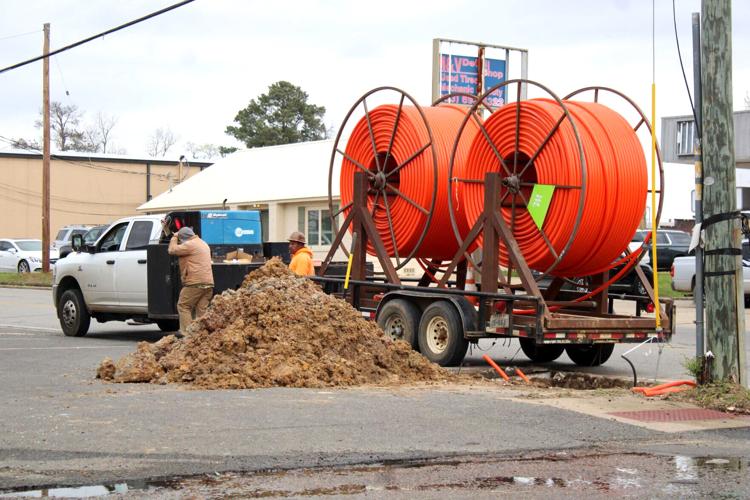
Credit: Mike Elswick, Panola Watchman File Photo
Longview News-Journal
By Jordan Green, Report for America/Longview News-Journal
January 1, 2024
The East Texas Council of Governments has almost wrapped up planning for 65 projects to expand broadband internet access throughout the region.
Soon, ETCOG officials will begin seeking more than $168 million in grant funding to bring those projects online.
Local governing bodies have approved 59 of 65 broadband expansion projects proposed by ETCOG, which is a coalition of cities, counties and schools from across 14 counties in the region.
Many of the projects would install fiber-optic internet infrastructure in areas where it doesn’t exist.
Much of the funding for those projects could come from state and federal grants. A state proposition that Texas voters passed in November set aside $1.5 billion for broadband expansion efforts, and a 2021 federal infrastructure bill allocated $3.3 billion for the Lone Star State to use.
If all of ETCOG's projects are implemented, more than 1,000 miles of broadband infrastructure will be installed across the region.
Projects are planned for 13 of the 14 counties in the council’s region. No projects are planned for Upshur County. As of Dec. 20, the only county that had yet to approve proposed plans was Henderson County.
ETCOG's plan
An estimated 7 million Texans — roughly 23% — don’t have reliable access to broadband internet, according to the Texas Broadband Development Office, a division of the Texas Comptroller’s Office overseeing internet expansion efforts. East Texas is among the state’s least-connected areas.
Broadband, which is high-speed internet, has a minimum download speed of 25 megabytes per second and an upload speed of at least 3 megabytes per second, according to the Federal Communications Commission.
The Broadband Development Office aims to improve high-speed internet access so Texans can work, attend school and receive health care online, among other goals.
Local agencies such as ETCOG will have roles in bringing broadband to their communities.
The majority of the council’s 65 projects would complete what economic development officials call “last-mile” internet service, said David Cleveland, ETCOG executive director. Last-mile service includes the cables and equipment that connect a home or business to an existing internet network.
That’s different from the costliest part of internet expansion in rural areas: creating middle-mile service, which includes all the equipment from an internet provider’s building to the place where connections to individual homes and businesses can be made.
ETCOG previously planned to build a regional middle-mile network, which would pave the way for last-mile service to be implemented at more locations that are offline.
However, some of the 65 planned projects will accomplish parts of that goal, Cleveland said.
For example, one of the projects planned for Van Zandt County would provide middle-mile infrastructure throughout the county, according to ETCOG's planning documents. A project in Harrison County would create a 142-mile ring of fiber-optic middle-mile infrastructure.
Because some of those projects would “preempt” a regional middle-mile network, building out that network isn’t ETCOG's top priority, Cleveland said.
“If we can do it reasonably inexpensively, we’ll probably do it,” he said of building a middle-mile network in the future.
The cost of the 65 projects will be $168.48 million, according to Lindsay Vanderbilt, ETCOG's director of communications.
Project highlights
Each of the participating counties was allowed a maximum of six broadband projects under ETCOG's planning, though some have fewer.
The three counties where the most broadband equipment installation is planned are Van Zandt County, with 214 miles of fiber-optic cable and related materials; Harrison County, with 194 miles; and Anderson County, with 156 miles.
In Wood County, ETCOG aims to install public wireless internet systems in the communities of Alba, Hawkins, Winnsboro and Quitman.
The only project in Smith County is set in in Whitehouse. It will be a trenching project that would allow internet service providers to run their own fiber-optic equipment in the city at a later date.
Smith County already is one of the more well-connected counties in the area because it’s home to Tyler, which has a large population and more internet access than neighboring rural areas, Vanderbilt said.
Similarly, Gregg County is more well-connected than other counties because it’s home to Longview.
In Gregg County, fiber-optic installation projects are planned near Gladewater, Liberty City and Easton. A roughly three-fourths-mile project is planned along East Loop 281 near the Harrison County line, and a roughly 3.5-mile project is set along U.S. 259 N near the Upshur County line.
ETCOG has created an interactive virtual map showing all of the projects throughout the region. To view it, visit go.etcog.org/ETCOGBroadbandInitiative .
'Micro-communities'
While not previously included in ETCOG's planning, some of the smallest communities in East Texas may have a chance at getting broadband access in the future.
The council aims to work with four to six regional “micro-communities” beginning next year to create wireless internet networks, Cleveland said. Fiber-optic internet networks would be too costly to build in these communities.
Lakeport, a community south of Longview with fewer than 1,000 residents, will be the pilot project for the expansion of wireless internet.
“We made this commitment to Lakeport that, once we got the main broadband planning process done, that we would start this,” Cleveland said. “That’s another big deal, and there’s nobody else — nobody else — in this state that’s even attempting this.”
The council will begin evaluating what those communities need for wireless internet expansion. Small city staffs in those areas may not have the time to handle broadband planning, which ETCOG aims to do, Cleveland said.
Applications begin
ETCOG and its partner agencies will begin applying for grant funding in January, Cleveland said. They’ll be looking to get their hands on billions in state and federal funds.
Texas Proposition 8, approved in November, created the state’s Broadband Infrastructure Fund. It sets aside $1.5 billion in funding for broadband expansion, money that came from the state’s budget surplus.
The state was allotted $3.3 billion in funding from the 2021 federal Infrastructure Investment and Jobs Act, according to the state comptroller’s office.
State funds could help cities, counties and economic development organizations obtain those federal funds, Cleveland said. All federal grants require local agencies to pay for some portion of a project, an amount of money called a “match.” In effect, it gives the local entity a stake in the process.
“The smaller the community, the less likely that they’ll be able to match these funds,” Cleveland said. “So, where the state can step in with this Broadband Infrastructure Fund and bridge the gap, that is golden.”
ETCOG also hopes to work with local foundations to seek funding.
The process of applying for grants will be collaborative. Some grants will favor a city government agency, internet service provider, county government agency or a development organization such as ETCOG. The council will guide its partner entities as they go through the application process, Cleveland said.
The council will add a staff member whose job, among other duties, will include finding funding for the projects.
“With this new staff member, we’ve got the bandwidth to focus on these things where the primary plan has taken our intentions so far,” Vanderbilt said.
ETCOG's planning for broadband expansion began in 2019. In November, the National Association of Development Organizations gave the council its 2023 Aliceann Wohlbruck Impact Award. The award recognizes agencies such as ETCOG that have made positive differences in the areas they serve, according to a news release. The award is named in honor of the national association’s first executive director.
“It’s something that we’ve just literally spent years on, so it means a lot to receive that recognition,” Vanderbilt said.