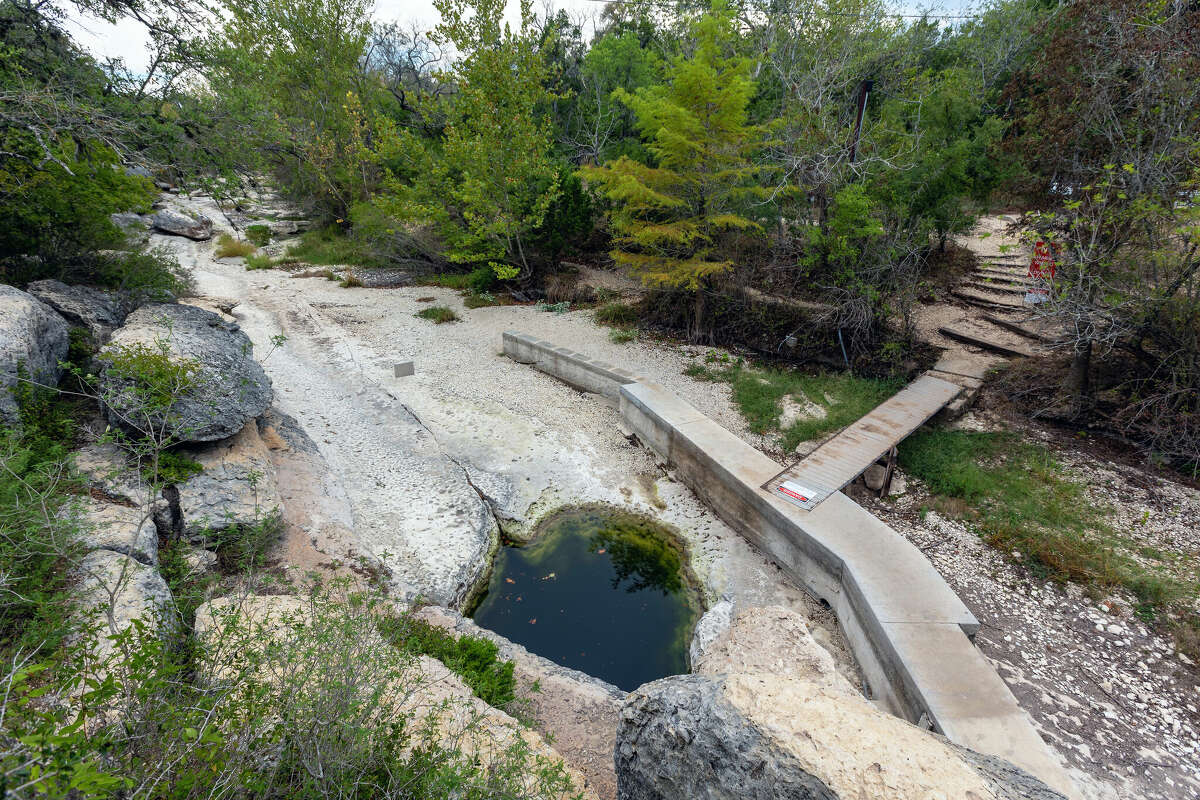
Water flow effectively ceased over the summer at Jacob's Well near Wimberley. The well-known swimming hole is fed by the Trinity Aquifer, which has been depleted by drought and an increase in water demand.
San Antonio Express-News
Liz Teitz, Wesley Ratko, San Antonio Express-News
In downtown Wimberley, signs warn about swimming at your own risk in Cypress Creek — but no one’s swimming as the water crawls slowly through the Hays County town.
A few miles away at Blue Hole Regional Park, the rope swings that typically launch swimmers into the crisp water below now hang still and quiet, and white lines on the tree roots show how far the water level has fallen. Upstream, nobody is splashing in the water at Jacob’s Well. The springs that feed the iconic swimming hole have stopped flowing for one of the few times in recorded history, closing the well for the summer.
And over on the Guadalupe River, there's not been much river at all since July — just a trickle of water here and there.
All those streams and springs are fed by the Trinity Aquifer — and their low water levels raise concerns about the Trinity's health and underscore just how important the groundwater system is for much of Central Texas.
The Trinity Aquifer is a key water source for the San Antonio and Hill Country area, and its health plays a key role in the health of another important water source, the Edwards Aquifer, which provides water for more than 2 million people. Protecting the Trinity and understanding how it functions and interacts with the Edwards Aquifer is of growing importance as drought and higher demand combine to make water supply an ongoing problem in Texas, experts say.
That's why the low water flows on the surface are so concerning for people such as Larry Hull, president of the Comal Trinity Groundwater Conservation District. The lower stream flows and spring flows, the underground water supplies falling, wells drying up — it's all interconnected.
“I look at them as the same,” Hull said. "To me, that’s indicative of the level of the aquifer going down, the lack of rain, the lack of springs.”
'A real complex formation'
Although the neighboring Edwards Aquifer gets more attention in and around San Antonio, the Trinity Aquifer's location and composition make it a key component of the Texas groundwater ecosystem.
The Trinity system stretches across 61 counties from northeast of Dallas to southwest of San Antonio covering more than 10,000 square miles at the surface and more than 21,000 square miles below ground. It runs throughout much of the Hill Country, including in Kendall, Comal, Hays and Blanco counties, and is considered one of the "most extensive and highly used groundwater resources in Texas" by the Texas Water Development Board.
Though often referred to as a single aquifer, the Trinity is really a group of aquifers, experts say. It’s divided into three units — the Upper, Middle and Lower Trinity — and within those are more layers, or strata, made up of different formations, all of which allow water to move through in different ways and at different rates.
Like the Edwards, the Trinity is a karst aquifer, meaning it is recharged by fractures in the surface that let water flow in. But the Trinity has fewer karst features in its surface than the Edwards does, hydrologist Doug Wierman said — so there are fewer ways for water to enter the system.
The amount of water entering the aquifer also varies by location, according to Marcus Gary, principal geoscientist for the Edwards Aquifer Authority.
Charlie Flatten, general manager of the Hays Trinity Groundwater Conservation District, said that “the Trinity is what we would call a tight aquifer,” so it’s hard to get water out of it and back into it.
Only about 5% of rainfall actually enters the Trinity to recharge it, Flatten said. When the ground is dry, as it has been most of this year, it’s even harder for water to make its way into the system.
The geology of the aquifer also means wells around the region can have vastly differing water levels. Because of fault lines or types of rock formation in the ground, even neighboring wells can be in different situations.
“Each area’s so uniquely different,” Hull said. “It’s just a real complex formation.”
The speed of water movement within the aquifer also can vary greatly, said Micah Voulgaris, general manager of Cow Creek Groundwater Conservation District, which is based in Boerne and manages groundwater in Kendall County.
In some parts of the county, “we might see really rapid water movement,” Voulgaris said, while in others, the formation is so tight that there’s little horizontal movement. He said he’s seen wells influence each other from a mile away, but in other areas, there’s little interaction.
The Edwards Aquifer has more permeability, which allows water to flow throughout the system more easily, along long flow paths. That makes it easier to monitor the Edwards' water level using fewer wells because it acts like a bathtub: Water entering in one part of the region results in higher levels across the system.
While the Edwards Aquifer Authority keeps data from dozens of wells, it relies on levels from the J-17 index well in Bexar County, along with springflows in New Braunfels and San Marcos, as the key metrics for drought restrictions. Because the Edwards is more permeable, Gary said, an index well such as J-17 is more reflective of the entire system.
“We can get rain in Medina or Bexar County and see a pretty quick impact at J-17 or Comal Springs, not just in a localized area,” Gary said.
That’s not the case for the Trinity. You can have wells a few miles apart, both in the Middle Trinity, he said, but their levels can vary dramatically depending on how connected they are to the karst features in that area. “It’s so highly variable in the Trinity that you need a lot more monitoring wells,” Gary said.
When water is pumped from part of the Edwards, the high permeability allows more water to flow in and replace it. In the Trinity, because the zones aren’t as connected, there’s less refill in some areas.
Despite their different structures, the two aquifers also interact with each other. That interaction happens primarily in two ways, Wierman said: Water that springs from the Trinity flows into rivers that then flow across the Edwards outcrop, where the water can enter the Edwards Aquifer.
Water also moves from the Trinity to the Edwards along the Balcones Fault Zone, the area along the path of Interstate 35 where fractures between rock formations allow water to flow from west to east, and from higher to lower elevations.
Researchers are trying to quantify how much water moves between the two aquifers, Gary said, but they do know there are connections between the systems.
That means the health of one system is tied to the other, so spring flows in one area should concern water users in another.
“If the Trinity is depleted and degraded, there’s less inflow into the Edwards,” Flatten said.
“The system needs to be healthy all the way to the springs,” Flatten said. “If any part of the conveyance system degrades, everybody downstream suffers.”
That's in part why the ongoing drought conditions in the area covered by the Trinity Aquifer have a wide-ranging affect across a wide chunk of Central Texas, including the San Antonio area.
'It's bad everywhere in the Hill Country'
Hull, of the Comal Trinity Groundwater Conservation District, has lived in the Hill Country since 1948 and can remember the record drought of the 1950s. “I think this one’s as bad or worse,” he said, because there are so many more people living in the area than there were in those days.
“It’s bad everywhere in the Hill Country,” Flatten said.
The Hays Trinity groundwater district — which stretches across the northern and western part of Hays County, including Wimberley and Dripping Springs — is in emergency conditions, cutting permit holders down to 60% of the water they're allowed to pump from the Trinity. The Cow Creek district is also under "drought emergency" regulations, and the Blanco-Pedernales Groundwater Conservation District, in Blanco County, is under restrictions that aim to reduce groundwater use by half. The Headwaters Groundwater Conservation District, in Kerr County, reached Stage 4 restrictions but recently dropped back to Stage 3 in early October, citing “slight recovery in the Lower Trinity Aquifer” as one factor.
On the U.S. Drought Monitor, a bull's-eye of “exceptional drought” still sits over much of Central Texas, and this summer it was “hot as the blazes,” Flatten said, speeding up surface water evaporation, without rain to refill and recharge the aquifer.
The problem didn’t just start with 2023’s record-high temperatures. Drought conditions compound over time. Over the past two years, “we’re hanging around 20 inches below average rainfall,” said David Baker, founder of the Watershed Association, a nonprofit based in Wimberley and focused on watershed protection and conservation. That lack of rainfall means the aquifers were already at a deficit before the hot, dry summer made things worse.
“Every Hill Country groundwater conservation district is in very poor condition,” Flatten said.
In western Hays County, “over the past two years, we’ve seen declines throughout the district,” Flatten said. It’s not localized in one area or another, which indicates that conditions are deteriorating across the board.
He gets one or two calls a week from someone whose well has gone dry, and he figures that’s probably just the tip of the iceberg because he’s not the first person a well owner would call.
To help protect existing permittees’ water, the Hays Trinity district has implemented a temporary moratorium on new nonexempt wells, meaning wells that aren’t used solely for domestic or livestock use.
Exempt wells, which make up about half of the district’s water use, can’t be denied permits under state law, so limiting the nonexempt wells is the only tool the district has to control demand for water from the aquifer.
The Cow Creek district has 43 monitor wells and averages them to measure water levels in the Middle Trinity, which is where 90% of wells in Kendall County get their water, Voulgaris said. In mid-August, the average water level in the monitor wells was more than 24 feet below the historical average for the month. That wasn't quite as low as the average water level in 2011, Voulgaris said — but it was close. The start of fall brought a little relief, with the deficit cut to about 23.6 feet as of the end of October.
Those monitor wells make up just a small fraction of the 9,500 registered wells in Kendall County; that number doesn't include wells drilled before 1972, when the county began keeping records, so the number could be closer to 10,000 or 11,000, Voulgaris said.
Wells are drying up in Comal County, too, Hull said. And some residents who are used to using their sprinkler systems to keep their lawns lush are having a “difficult time” with conservation, he said — but the district, which was only formed in 2015, doesn’t put mandatory restrictions on pumping or water use, just strong encouragement to use water responsibly.
'We've got to get smarter'
With no end yet to the drought and with the area's population boom expected to continue, the strain on the Trinity Aquifer is only going to continue, experts say.
Northern Hays County is one example. The population served by the Hays Trinity district has more than doubled in the past two decades, from about 24,000 in 2001 to more than 53,000 in 2020. That translates to more straws pulling water out of the cup — while hardly any rain falls from the sky to refill it.
“The more wells that you have, the greater the impacts are going to be,” Wierman said.
At a recent meeting in Bulverde hosted by the Comal Trinity groundwater district, residents asked why development is allowed to continue despite deteriorating conditions in the aquifer. But counties have limited authority and can't prevent development in unincorporated areas, leaving them with few tools to ensure that existing water supplies are enough to keep up with new growth.
Conservation districts, tasked by state statute with balancing "the conservation and development of groundwater" and protecting private property rights, also have limited ways to preserve water supplies.
“The fact that no groundwater district has authority to limit growth and no groundwater district has the ability to make it rain more, those are the two big variables, demand and supply,” Flatten said. “We don’t have any control over demand or supply. All we get to do is manage how that water is used, and we’ve got a fairly weak set of tools that allows us to do that.”
Overpumping is also a problem. The Hays Trinity has issued a $448,000 fine to Aqua Texas, a private utility company that the district says pumped twice as much as it was allowed to during drought conditions. Flatten said negotiations are ongoing, with the district board's primary goal being compliance, and eliminating water loss from the company's system. If an agreement isn't reached by Jan. 1, the company will be operating without a permit, he said.
Those limited tools leave districts focused largely on education: trying to explain that people can’t have an expectation of a very green yard on the edge of a desert and encouraging water reuse systems and rainwater harvesting systems.
“We’ve got to get smarter at how we use water,” said Wierman, a former member of the Hays Trinity groundwater district's board. Estimates vary on how much water is used for outdoor landscaping and lawns. The Cow Creek groundwater district says that use makes up about 40% of household water use, while Baker said it's more than half and Wierman estimated 0% to 35%. But in these conditions, he said, using that amount of water to keep grass green doesn't make sense.
He said he’d also like to see water priced in a way that discourages waste, hitting people in the pocketbook if they don’t conserve.
While some people are aware of the situation and working to cut their use, Flatten said there’s an equal number who are “completely disengaged” from the drought, as long as water keeps coming from their faucets.
“Utilities need to be much more aggressive about their education and outreach,” he said.
A tipping point is coming for those who rely on the Trinity Aquifer, Flatten said.
“At some point,” he said, “we’re going to have to decide whether we want green grass or to be able to flush our toilets.”