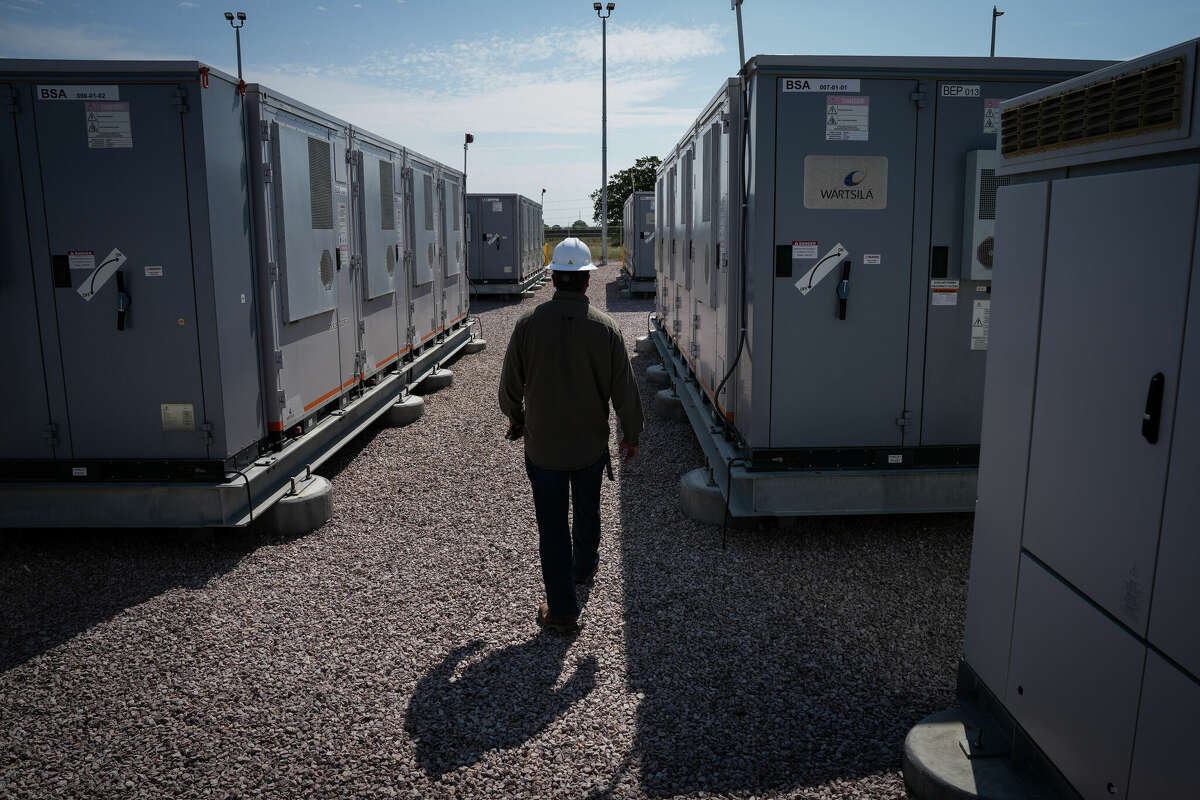
Battery sites like this one at Enel Green Power’s Blue Jay solar and storage plant in Iola are excluded from incentives that would be available under Proposition 7, which is on Tuesday’s ballot.
Jon Shapley/Staff photographer
San Antonio Express-News
Sara DiNatale, Staff writer
It’s been sold as a solution to issues that led to deadly blackouts two years ago, but energy experts say a Texas constitutional amendment heading for approval this week won’t greatly expand the state power grid’s capacity or improve its reliability.
Among the reasons for their caution is that Proposition 7 — which would create a program dubbed the “Texas Energy Fund” — fails to address the changing reality of the grid overseen by the Electric Reliability Council of Texas. And it ignores major, growing pieces of it.
“In a complex situation, you want every tool in the toolbox, but the Legislature saying you can only use a wrench when you need a hammer, pliers or a screwdriver seems silly,” said Michael Webber, a professor of energy resources at the University of Texas at Austin.
If passed by voters Tuesday, the $10 billion amendment will put $7.2 billion into a low-interest loan program to pay for one grid tool: maintenance of existing natural gas-powered plants and construction of new ones. Battery storage and renewable sources — such as wind and solar generation — are excluded. An additional $2.8 billion would provide grants and loans to create microgrids and support utility projects outside the ERCOT region.
In Webber’s view, it’s a legislative mandate, not a market solution.
While early supporters included oil and gas giants such as San Antonio-based Valero Energy Corp. and industry groups including the Texas Association of Manufacturers and the Texas Oil & Gas Association, one constituency was conspicuous by its absence: the utility companies that presumably would benefit. They were critical of the idea passed by the Legislature this summer and sent to the ballot with Gov. Greg Abbott’s signature, saying it should be broadened to support all types of capacity added to the grid and not just just gas, coal or nuclear plants.
But as election day arrives, mail ballots roll in and projections show the amendment is likely to pass, utility companies have come out in support despite those reservations. The state’s creaky electric grid needs whatever help it can get, they say.
“Right now, you need any megawatt you can get your hands on,” said CPS Energy President and CEO Rudy Garza. “And any solution we put forward that helps get a megawatt of power is a good thing. Beggars can’t be choosers when we’re chasing the growth in the state of Texas.”
Tony Bennett, president and CEO of the manufacturers association, put it this way:
“Our grid is out of balance,” he said. “We welcome renewables, but they are intermittent. Many times, they have to be backed up by base load power, dispatchable energy. … We have a shortage of dispatchable energy, and this is what we are trying to incentivize.”
Little impact
But with utilities such as CPS and others shutting down aging and outdated coal and gas generating plants and replacing them with power sources that are not supported by the loan program, an independent analysis found that the program is unlikely to add significant capacity in the near term.
Joshua Rhodes, a UT-Austin grid researcher who conducted the analysis for the Texas Consumer Association, said his modeling found that without the program, Texas would face a net loss of 14 gigawatts of gas-powered generation. With it, the loss would be 13 gigawatts.
And, he said, the plan is not likely to incentivize much new capacity.
Webber said that’s also because it omits other types of generation.
“Incentivizing gas but not wind or solar with batteries, that’s the sign this is not really about building more power plants,” he said of the Legislature. “It’s a sign that they want a particular form of dispatchable energy. Meanwhile, other forms of dispatchable power … are ignored.”
Those “ignored” power types include battery storage, hydrogen and bioenergy, Webber said.
He said he’d rather see lawmakers setting criteria to guide what a utility must accomplish in delivering new capacity and for the program to offer the loans regardless of the resource that will bring additional electricity to the grid.
While the battery industry says storage systems — which can be charged from the grid or renewables — can be as reliable as fossil fuel power plants in offering a quick supply, regulators and state leaders have been hesitant about their dependability.
Because amendments are codified into the state constitution indefinitely, critics worry the legislation’s tie to natural gas will mean funding will go to those using fossil fuels even if they’re no longer the best option amid the industry’s rapidly advancing technology.
“And every legislative season they can decide to take more taxpayer dollars and dump it into this fund,” said Sandra Haverlah, who leads the Texas Consumer Association, which opposes the amendment. “And every time, it’s an opportunity for them to subsidize political partnerships. And that’s not a free market.”
The biggest miss, Webber said, is that the legislation doesn’t view growing demand-response programs — such as paying residential customers for reducing their power consumption — as a viable solution worth incentivizing.
That sentiment was echoed by Haverlah. She wants to see customers paid for adjusting their power use during tight periods and getting paid for it — just like many large commercial users are already paid for cutting back when supply is short.
“Why give away billions to these companies?” she said.
Instead of ERCOT begging for customers to reduce their power use when supply is tight — a request it made nine times as the grid struggled to keep up with summer demand between June and September — Haverlah said the grid operator should work with utilities to award customers with credits on their bill for making that sacrifice.
Not just gas, but …
“Dispatchable” is a term for power that can essentially be switched on and off quickly so it can be relied on as demand fluctuates. That’s what the Legislature’s amendment is focused on.
Historically, dispatchable energy has meant gas- and coal-powered plants. Nuclear plants also would be covered, but those plants are more expansive and can take six or seven years to build. A gas-fired plant can be running in about half that time.
The market has also moved away from coal, making it unlikely any company would invest in such a plant even with the incentives offered.
That’s why critics of Proposition 7 say it’s putting a thumb on the scale in favor of the oil and gas industry: In reality, a gas-fired plant is the only type that would qualify.
The program works by providing 20-year loans at 3% interest for generation added within ERCOT’s jurisdiction, which covers 90% of the state. The Public Utility Commission of Texas will act as the bank doling out the loans and bonuses when new capacity is added by certain deadlines.
In San Antonio
The situation is illustrated in San Antonio by CPS’ long-term generation plan. It calls for converting one of the coal-burning units at CPS’ J.K. Spruce Power Plant by the end of 2028 and converting the plant’s second unit — Spruce 2 — to run on natural gas. CPS also is putting hefty investments into wind, solar and battery storage.
Garza estimated the expense to switch Spruce 2 to gas would cost about $60 million. The city just hired an engineer to begin planning for the transition, and CPS has said it wants it to be running on gas before the end of the decade.
Currently, CPS has eight peaking power plants, or peakers, which run only when demand is high. They can power up within five minutes, Garza said.
“They’re basically jet engines,” he said.
CPS is planning to add more such plants, which could add as much as 400 megawatts to its total generation. The loan program created by Proposition 7 is aiming for that kind of added capacity.
While a larger natural gas plant could take between four and six years to plan and build, peaker plants could take three or fewer years, Garza said. But a lot of that timeline depends on supply. The industry still is dealing with manufacturing shortages stemming from production slowdowns and shutdowns during and the pandemic.
Wattbridge, a company created to address the need for peaking power to support the transition to renewables, announced this year that it would build a new 288-megawatt peaker in Brazoria County. Another company, Enchanted Rock, has been steadily building self-sufficient microgrids for backup power, to which the PUC also can provide grants to build under the amendment.
UT’s Webber said such developments show the market already is moving to support the energy transition — but not as fast as lawmakers want it.
“Things are getting built,” he said. “But it’s not happening as much as the politicians want. They want more, but the markets aren’t calling for it.”
‘Dependent on renewables’
Already, the ERCOT grid is “dependent upon renewables to meet demand,” CEO Pablo Vegas said in late July. While ERCOT had to declare emergency conditions in September when demand nearly outpaced supply, industry leaders agreed conditions would have been worse without wind and solar power that kept the grid afloat.
But Vegas has voiced concern that the grid is increasingly unbalanced because new coal- and gas-powered plants haven’t been brought online at the same pace as less expensive and quicker-to-build wind and solar generation is being added.
The tightest periods for the grid now coincide with the times the sun is down. This summer, that meant the grid was tight in the evenings after sundown but before the day’s heat subsided. Heading into winter, utilities and the grid operator are concerned about cold mornings before the sun rises.
During a recent PUC meeting, Vegas said he saw Proposition 7 and a performance credit incentive program that’s in the works as parts of a solution to such grid volatility. He said he hoped voters pass the amendment.
“We’ll see those incentives combined to incentivize a more balanced development strategy going forward, and that’s what we’re looking forward to and what we’re building towards,” he told commissioners.
What’s next
NRG Energy, one of the state’s biggest power generators, said in a statement last week that it’s pushing for a “comprehensive, long-term approach to bringing new investment in dispatchable generation.” It said it views the funding through Proposition 7 as a “temporary bridge to spur new investment.”
If the amendment passes, NRG said, it may add peaker plants to its portfolio.
During a legislative hearing in May, Mark Bell, president of the Association of Electric Companies of Texas, told lawmakers his members were worried about government intervention creating an unlevel playing field.
In a statement to the San Antonio Express-News last week, though, Bell said the association now supports the amendment.
“Many of our member companies are reviewing the programs that would be funded by its passage,” he said.
In San Antonio, Garza said that while he hopes Proposition 7 is approved and that CPS is likely to use its incentives, he is going to be thinking long term about expanding the utility’s natural gas generation. He doesn’t want to repeat mistakes of the past.
The Spruce 2 plant was just built in 2010, and now the industry is rapidly moving away from coal. Garza admits it wasn’t a wise long-term investment.
Now, natural gas is the workhorse of the power grid — but it can be unreliable at times. During periods of extreme cold when energy is needed most, for example, well heads and pipelines can freeze. That scenario played out during Winter Storm Uri in 2021, when power outages and severe cold led to the deaths of 246 Texans.
“I don’t want to build a 600-megawatt billion-dollar gas plant without thinking through the long-term ramifications of how long I can run that plant,” Garza said. “I’m not going to put the community in the same position of having to walk away from an asset of that scale.”